Tuesday, February 22, 2011

I Saw the Devil


Ji-woon Kim directs the aptly titled vengeance tale I Saw the Devil. The two main characters learn about the devil in themselves by looking at one another.

Kyung-Chul (Min-sik Choi) murders women. Resilient and wily, he is also so insane that he is almost hapless in his understanding of the world. One winter's night, he butchers Joo-Yeon (San-Ha Oh), a young woman who is pregnant by her fiance Kim Soo-hyeon (Byung-hun Lee). Joo-Yeon's detective father feels guilty for not being able to protect his own daughter, but he tries to be thankful for at least finding her dismembered body. He and his other daughter find space in their grief to worry about Soo-hyeon.


A skilled special agent, Soo-hyeon takes it upon himself to find the killer. We follow both Soo-hyeon and Kyung-Chul as the former brutalizes suspects and the latter prowls for more victims. When Soo-hyeon finds Kyung-Chul, he abuses him to near death before pulling back and leaving him money. With the help of an implanted tracking device and microphone, Soo-hyeon later finds Kyung-Chul so he can repeat the torture.

Kyung-Chul mentions his strange stalker to an equally mad friend, who points out that his pursuer is enjoying the hunt in the same way they do. Kyung-Chul contemplates this and begins to enjoy his and Soo-hyeon's symbiotic relationship. Soo-hyeon's sister-in-law tells him that there is no meaning in taking revenge on a crazy man. Soo-hyeon claims there is, and the audience wonders when he will deem the punishment complete.


Touches of ironic humor are sprinkled throughout the film. The deranged killer calls others "crazy retards" or "psychos." One scene shows his reluctance to get into a taxi after he has lured so many women into his vehicle.

For those who don't love gore, this film is nauseatingly violent. The protagonist's brutality is shown more graphically than the criminals'. Due to excessive blood-letting and lingering shots on defenseless women, the message that retribution calls forth an unwelcome monster is difficult to take seriously. However, the film's final minutes are chilling. The grisly action pauses long enough for us to witness what is within the two men. I Saw the Devil's harrowing conclusion powerfully examines the pointlessness of sadism.

Monday, January 17, 2011

Downton Abbey: Season One


"Don't you care about Downton?"
"What do you think? I've given my life to Downton."

The opening image of a beautifully lit telegraph cuts to that of a train barreling towards the audience. Its whistle interrupts the Morse code, signaling music that complements the engine's chugs. A man stares out the window at sweeping landscape, which is obscured somewhat by steam and telegraph poles. Set in the years preceding the Great War, the prevailing theme in Downton Abbey is change.


We are soon introduced to residents of an Edwardian manor. Servants rush through the early morning, commenting on newly installed electric lights and quipping at lesser servants. Upstairs, family members wake with leisure and descend the staircase with grace.

In the first episode, Robert Crawley, the lord of Downton Abbey and Earl of Grantham, played by Hugh Bonneville, discovers that he must find a new heir. He and his American wife Cora (Elizabeth McGovern) have only three daughters, and his nearest male relative is middle class lawyer Matthew Crawley (Dan Stevens). Even the servants realize that this, as one says, is "more than a shame--it's a complication."


Marvelous acting and a remarkable script bring to life the community of nearly twenty main characters. Bonneville's Robert is the definition of noblesse oblige, old fashioned but benevolent, while McGovern's elegant Cora conveys an American warmth. Michelle Dockery is excellent as Mary, their eldest daughter, who is at turns cruel, charming, and self-deprecating. Laura Carmichael plays Edith, the neglected middle sister, and Jessica Brown-Findlay is the sweet and observant youngest, Sybil.

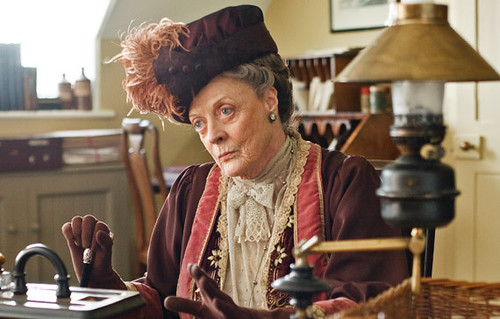
The most hilariously acerbic lines are spoken by Robert's mother Violet. Maggie Smith plays Violet with enough wit to keep her both obnoxious and endearing. Her rival is Matthew's forward thinking mother Isobel (Penelope Wilton), who is initially less reluctant than her son, snobbish in his own way, to become embroiled in the Earl's family.


Butler Mr. Carson (Jim Carter), a fierce defender of Downton's honor, and wise housekeeper Mrs. Hughes (Phyllis Logan) oversee the staff. New valet John Bates's (Brendan Coyle) limp causes a stir, but competent head maid Anna (Joanne Froggatt) is attracted to his kind demeanor. First footman Thomas (Rob James-Collier) dislikes him and seemingly everyone else except his mentor, the manipulative lady's maid Sarah O'Brien (Siobhan Finneran).

Gwen the maid (Rose Leslie) hopes to leave service, while the frequently flustered kitchen maid Daisy (Sophie McShera) dreams of pleasing the loud-voiced cook Mrs. Patmore (Lesley Nicol), and second footman William (Thomas Howes) pines for home.


Even the most conservative characters are torn between tradition and progress, and the most loathsome have moments of vulnerability and humor. The writing relies on psychological glimpses instead of heavy handed psychoanalysis and is aided by the expressive cast.

Downton Abbey is not politically correct. At times, unsavory characters bitterly espouse equality, and minorities are negative figures. We don't see backbreaking alternatives to service or closeups of the scullery maid's calluses. What Downton's lovely visuals lack in grit, the show compensates for in emotional texture. We witness the effects of bad company and resentment as well as good advice and loyalty.


This world is both familiar and exotic, making it a fascinating study in personality and culture. Its residents adjust to telephones and cars, but most of them have only a faint idea of impending social change and even less knowledge of the devastation at hand. As that cloud hangs on the horizon, characters are caught up in their own lives, and, for the time being, so are we. There is something intoxicating about getting lost in the intrigues of Downton Abbey.

Saturday, November 27, 2010

Harry Potter and the Deathly Hallows: Part One


Though Harry Potter and the Deathly Hallows: Part One is a blockbuster about teenage wizards, the seventh in the Harry Potter series is more ambiguous and thematically relevant than many movies about adults. The plot will baffle those who have either not seen the previous film or read J. K. Rowling's bestselling books.

The wicked Voldemort (Ralph Fiennes) gathers his band of Death Eaters to create a world where muggles (non-magical humans) are subservient to wizards. Voldemort himself echoes Hitler's makeup in that he is half-muggle, and pamphlets strewn throughout the film (including one titled "when muggles attack") resemble Nazi propaganda.

Meanwhile, Harry Potter (Daniel Radcliffe), Hermione Granger (Emma Watson), and Ron Weasley (Rupert Grint) abandon their final year at the magical school of Hogwarts to embark on a quest to destroy Voldemort. To do this, they must find six horcruxes, objects containing pieces of Voldemort's soul.


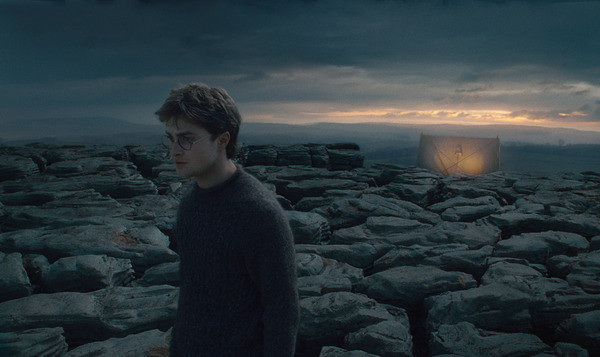
Deathly Hallows: Part One, the second to last film, is more appropriate for teenagers than young children. From the barren scenery to the shuddering, downcast portrait of Harry on a wanted poster, a sense of despair pervades the atmosphere. As our three young heroes struggle with uncertainty, their friendship is put to the test.

Seasoned British thespians including Bill Nighy and Helena Bonham Carter have little more than cameos, but most minor characters are well handled. Memorable roles include Alan Rickman's icy Snape, David Thewlis's kind werewolf Lupin (in human form), and Imelda Staunton's creepy interrogator Dolores Umbridge.

Voldemort's hosts, Death Eaters Draco (Tom Felton) and Lucius Malfoy (Jason Isaacs), exemplify the crumbling upper class. Humiliated by Voldemort and lower-class thugs, the snobbish Malfoys discover how overturning the social order can negatively affect them.


The odious but helpful house-elf Kreachure, a CGI creation, is marvelously voiced by Simon McBurney. The more heroic house-elf Dobby (Toby Jones) is less successful. He comes across as more cartoonish than inspiring.

But the heart of this film is the trio. Due to the amount of material crammed into each movie, Hermione and Ron have often felt more like sidekicks than complete characters. Here their acting, especially Ms. Watson's, has improved and their conflicts are fleshed out.

We see Hermione's sacrifice as she erases her muggle family's memories in order to protect them. One of the youngest and least powerful in a large family of strong wizards, Ron and his insecurities also emerge, as does his resentment about the relationship between the famous Harry and overachieving Hermione.


Ron and Hermione's unspoken romance is humorous, frustrating, and sweet. While Hermione notes that she is "always mad" at Ron, she and Harry have a more harmonious and platonic connection. Their closeness is demonstrated in the film's most moving scene, when Harry dances with Hermione. Though not in the book, this moment of joy is a counterpoint to the darkness that takes up so much of the film, and the dance dissolves when they recall the complexity of their situation.

The most creative part of the film, arguably of the entire series, is a curious but fascinating animation of The Tale of the Three Brothers. Nicely read by Ms. Watson, the story of Death's encounter with three brothers is grim, eerie, and hauntingly beautiful.

The film is by no means perfect. It has its share of melodrama, and Alexandre Deslpat's usually lovely score can be laughably over-the-top. Long pauses prolong an already lengthy movie. Part One's abrupt ending isn't particularly satisfying; the audience will have to wait until Part Two for a real conclusion.


Still, it is touching to see the tired and worn triumvirate walk past charred trailer homes as they listen to death tolls on the radio. Hardly older than children, they have to learn that heroism is more tedious than glorious. With only one more film to go, Harry Potter and the Deathly Hallows: Part One manages to be the most emotionally resonant Harry Potter movie yet.

Monday, November 15, 2010

The Kids Are All Right


Though The Kids Are All Right never surpasses the threshold of greatness, the film is an intelligent take on familial and romantic relationships.

While Nic (Annette Bening) and Jules (Julianne Moore) struggle with their marriage, their daughter Joni (Mia Wasikowska) faces graduation. Meanwhile, their son Laser (Josh Hutcherson) contacts his biological father, the free spirited Paul (Mark Ruffalo) who donated sperm when he was a young man. As Paul is increasingly intertwined in his "children's" lives, his role in the family becomes more complex.

There are no villains here. Nic's controlling nature is somewhat overemphasized, but Bening remains sympathetic and humorous. Moore is likewise engaging as the appealing but insecure Jules. Ruffalo is excellent as the laid back Paul. His unexpected reactions to having a family of sorts are fascinating but a tad underdeveloped.

Joni and Laser are perhaps the most well drawn characters. In fact, their stories could have been explored more. The siblings have a close but imperfect connection. They are sarcastic, naive, endearing, and a refreshing departure from unrealistic teenage stereotypes.

The Kids Are All Right touches on everyday questions of patience, disappointment, and love. The movie sometimes strains to find the right amount of quirk, but it's a rare film that is both enjoyable and smart, and thus worth seeing.

Sunday, November 14, 2010

Daniel & Ana


Daniel & Ana is named after the wealthy siblings Daniel and Ana Torres. Daniel attends high school as Ana prepares for her wedding. Daniel tentatively moves forward with his girlfriend. His biggest concern is not owning a car. Ana's problem is that her fiance Rafa has been offered a job in Spain. He wants to take the job; she wants to remain in Mexico City with her family. Then three men kidnap the brother and sister and sexually assault them in a way that makes them feel especially culpable. They are released physically unharmed but in a state of complete shock.

The acting is excellent, especially by Marimar Vega as the sexy and confident Ana. The scene in which she and Daniel are kidnapped is chilling and graphic. The also beautiful Dario Yazbeck Bernal successfully conveys Daniel's vulnerability. However, though their initial paralysis is portrayed with painstaking realism, the audience sees absolutely no line between the initial assault and Daniel's eventual actions. His later reaction comes across as unbelievable and sensationalistic. The clueless parents are not at fault, but they are pushed to the background and thus not particularly sympathetic.

Clinically shot and scored with overplayed bits of classical music, this attempt to raise awareness about coerced victims of pornography is ostensibly a true story. Unfortunately, this tale of close siblings forced apart is more disturbing than moving, thanks to muddy psychology.

Spanish with English subtitles

Sunday, November 7, 2010

The Young Poisoner's Handbook (1995)


Benjamin Ross's gruesome but hilarious The Young Poisoner's Handbook is based on the true story of Graham Young. Played by Hugh O'Conor, Graham is a teenage genius whose fascination with chemistry doesn't bode well for those who rub him the wrong way. The movie's cast of cartoonish characters are as unlikeable as Graham, though not nearly as intelligent. Graham's awful family is a macabre parody of an ideal British 1960s household. A psychiatrist played by Antony Sher is the only character with any sign of subtlety or decency. In spite of its disturbing content, this fast paced film is filled with humorous juxtapositions and ironies. Still, The Young Poisoner's Handbook is, at the end of the day, a strangely believable portrait of cold madness.

Monday, October 25, 2010

Orlando


Originally distributed in 1992, Sally Potter's film Orlando was re-released last summer. Ms. Potter adapted the screenplay from Virginia Woolf's 1928 novel Orlando: A Biography about an individual who changes genders halfway through her over four-hundred year long life. The movie is divided into seven sections: Death, Love, Poetry, Politics, Society, Sex, and Birth.

Excruciatingly slow and cryptic, Orlando is nonetheless a gorgeous work of art. Its enthralling music, mostly composed by Ms. Potter and David Motion, contributes to the film's dreamlike ambiance. Orlando's color palette is also extraordinary. Cinematographer Aleksei Rodionov shoots the Rococo period's pastel blues and pinks in muted light. Candles illuminate the Renaissance's bold outfits and elaborate rituals.


Tilda Swinton looks the part of the androgynous Orlando, but the movie's acting and writing are stilted and bizarre. Amongst the film's many unsubtle messages, its most powerful theme is that of identity. Though difficult to get through, Orlando has an entrancing originality.