Sunday, April 25, 2010

My Name Is Red

The person who recommended Orhan Pamuk’s My Name Is Red confessed that it was one of the most difficult books she had read. It sounded gorgeous: told from different perspectives, including figures in ancient illuminations, a contemplative murder mystery unfolds during the Ottoman Empire’s sixteenth century. The book won the Nobel Prize in Literature, as well as a variety of other awards in multiple languages. The likes of The New York Times Book Review, The New Yorker, Los Angeles Times, and The Economist Reviews cited: “A modern classic,” “a tour de force,” “Astonishing,” “magnificent,” “Shakespearean in its grandeur,” and “demonstrates the patience of … Proust and Mann, [while] his instinctive affinity lies with … Calvino and Borges.”

So instead of getting it from the library, I bought it. I love art and philosophy.

I stopped reading after 75 pages.

The story began from the fascinating viewpoint of a murdered corpse. Yet, my first doubts arose when he cadaver told about the afterlife. Instead of shedding light or adding suspense, the description of life after death merely made me think, “Well, I guess people can make up what they want when it comes to the afterlife.” After several chapters, my illusions that the book was made of interweaving threads fell away. I was reading one story, containing many different stories within it. These tales included lessons that, to me, didn’t seem particularly noteworthy. Even after gleaning the exact same lesson from five different stories.

Any depth of personality eluded me. No character held my interest. The women were objects of wit and desire, and the men were hardly more rounded. Rapists and torturers were described as enlightened and gentle. This may have been an attempt to depict the mindset of individuals at the time. Instead, the vaguely sketched characters are dull.

The translation was also off-putting. Characters speaking in formal settings dropped the f-bomb. Not the foul but the inappropriate language bothered me.

I’m sure that the characters and narration style were meant to imitate illuminations themselves as well as traditional storytelling. I’m also certain that there was a cultural difference that I was unable to overcome.

The person who recommended the book to me said that she had to put the book down for at least a year the first time she picked it up. I will also put it down for at least a year. At least.

Thursday, February 25, 2010

Shutter Island


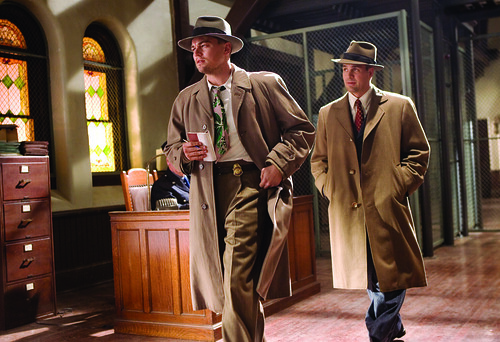
Martin Scorcese's 'Shutter Island' may not be as praised or praiseworthy as his recent film 'The Departed,' but it is nonetheless a successfully tense viewing experience. Leonardo DiCaprio is, as expected (lately), powerful, almost overwhelming, as the tumultuous marshal Teddy Daniels. He has been sent to investigate the disappearance of a woman on an island off Massachusetts that consists solely of a prison for the criminally insane. On the ride over, he meets his new partner Chuck (Mark Ruffalo), and at the institute, he encounters a variety of cryptic doctors and disturbed patients.

Dr. Cawley (Ben Kingsley) appears to be a forward thinking psychiatrist, while the German Dr. Naehring (Max von Sydow) espouses harsher beliefs about the mad. Between unfruitful interviews, Teddy dreams of his dead wife Dolores (Michelle Williams) and recalls the liberation of the Dachau concentration camp, of which the fenced in island is eerily reminiscent. Kingsley and von Sydow are reliably subtle. Emily Mortimer and Patricia Clarkson are likewise excellent in very different roles.


Progressively surreal circumstances make both Teddy and the audience increasingly uncomfortable. The surprisingly straightforward ending has been criticized as cheap and predictable. However, it has enough substance to make the viewer consider seeing the film twice.


Problems include one too many smiles by crazy folks. Instead of creepy, they come across as cliche. Also, though visually astounding, flashbacks and dream sequences lack intriguing dialogue. Per usual in adaptations of Dennis Lehane novels (Gone Baby Gone and Mystic River), the love interest is more a foil to the male protagonist than a fully developed character.


The movie's slow pace resembles the similarly scored Stanley Kubrick classic 'The Shining.' Though 'Shutter Island' doesn't reach those heights, it is good in its own right, especially towards the middle of the piece, when viewers don't know what to think or hold on to.

Sunday, January 17, 2010

Brief Interviews with Hideous Men (movie)


I have not read David Foster Wallace's story collection "Brief Interviews with Hideous Men." As of yet, I have only seen John Krasinski's film of the same name and subject.

This movie is viewed
best as an overview of a certain mindset rather than of all men. Comprised mainly of a series of interviews performed by a female interviewer (Julianne Nicholson). Male subjects include both strangers and close acquaintances. Nicholson is excellent, especially considering she is mostly silent. All women characters lack a voice here. This clearly symbolic reinforcement of women as objects and victims is interesting but also an easy evasion of creating the rare three-dimensional female characters.

The inconclusive interviews are, at times, frustrating. In fact, several cut off when the subject is about to confess his most important theory about himself or women. Perhaps the point here isn't so much what these men believe; it's that they believe they are right. Many stones are left unturned, as there really is only one general theme in a variety of guises, that of objectification. Here, male insecurities and self-hatred lead to misogyny. Men ruminate on the female mystique. One man describes objectification related more to race than gender. The pieces range from humorous, inoffensive, and light, to powerful and truly sickening; some are both.

'Brief Interviews with Hideous Men' has received mainly negative reviews. In spite of its flaws, the movie is
funny, disturbing, and, ultimately, intense.


Saturday, December 26, 2009

Favorite TV, by year (because I couldn't decide the order)

Note: I haven't seen The Wire, which I'm told I'd love.


Law & Order (1990-present). Though sometimes heavy handed and formulaic, this show has provided countless hours of good drama. Crime/Mystery/Drama.


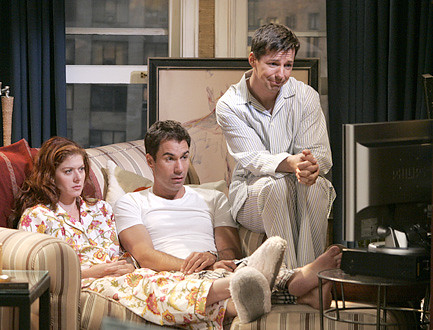
Will & Grace (1998-2006). In spite of its self-consciousness, this sitcom's humorously self-centered characters make the show amusing and lovable. Comedy.


Angel (1999-2004). A supernatural soap opera that is angsty and epic. Action/Drama/Fantasy/Thriller. (Top 6.)


The Office (UK) (2001-2003). A biting, brilliant satire set in the working world which is dark, realistic, and absolutely hysterical. Comedy/Drama. (Top 6.)


Six Feet Under (2001-2005). A beautiful and therapeutic take on life and death. Revolves around a family-run funeral home. Drama. (Top 6.)


Firefly (2002-2003). This funny, exciting, and original space Western features a fantastic crew of characters. A pure delight. Drama/Sci-Fi. (Top 6.)


It's Always Sunny in Philadelphia (2005-present). While the recent episodes have been more strained, this series about stupid, terrible people includes some of the most hilarious stuff I have seen. Comedy. (Top 6.)


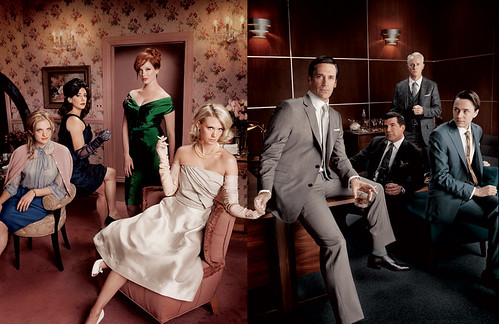
Mad Men (2007-present). Occasionally too composed, self-satisfied, and unfulfilling, this show about 1960s "ad men" is still very intelligent, at times scary, moving, and comical. Drama.


Dollhouse (2009-present). As far as I can tell, unlike any show ever made. That's a compliment. Extremely thought-provoking, multi-layered, and intense. Drama/Sci-Fi/Thriller. (Top 6.)


The Vampire Diaries (2009-present). This entertaining teen drama (with ghostly and vampiric danger thrown in) is like tasty junk food. Good for what it is. Drama/Horror/Romance.


Tuesday, November 17, 2009

Firefly: The Place to Go for Villains (Spoilers for Dollhouse)

I just want to point out that a large percentage of actors from Joss Whedon's television show 'Firefly' feature as villains in other shows. Five of the nine central characters are adversaries in other Whedon shows (more than half - that's a lot), and one more is a baddie in a new science fiction show (2/3).

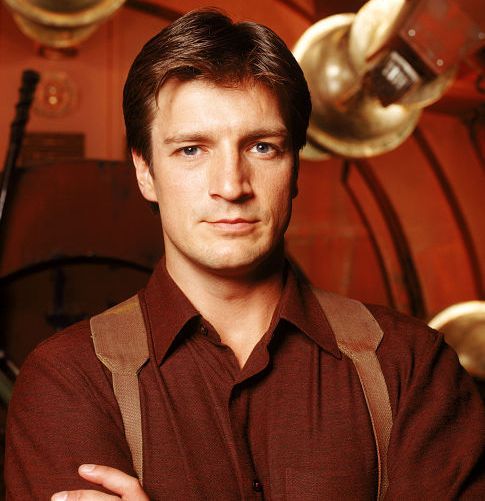
Nathan Fillion, the hilarious and rebellious Captain Mal Reynolds on 'Firefly.'


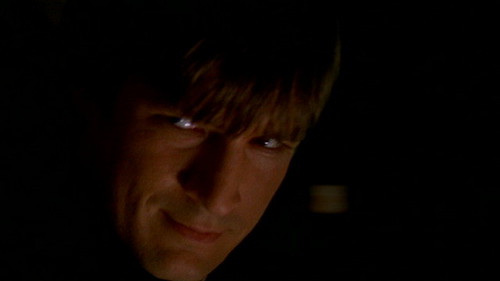
On 'Buffy the Vampire Slayer' as as Caleb, a misogynistic former priest and serial killer (I never actually saw him on this).


And extra points as the reprehensibly arrogant Captain Hammer, both the antagonist and "hero" of 'Dr. Horrible's Sing-Along Blog.'


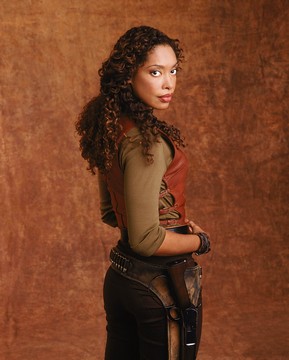
Gina Torres on 'Firefly' as the badass Zoe Washburne.


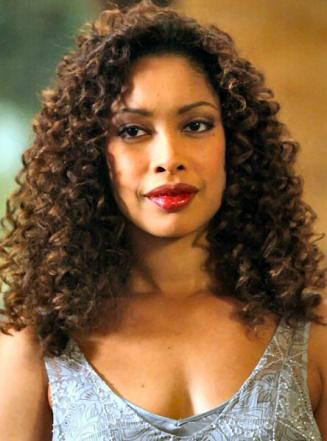
On 'Angel' as the creepily serene and lovey-dovey goddess Jasmine.


Adam Baldwin plays the ignorant, amoral, and extraordinarily macho Jayne Cobb on 'Firefly.'


Still large, but much more polished as the sinister 'Angel' character Marcus Hamilton.

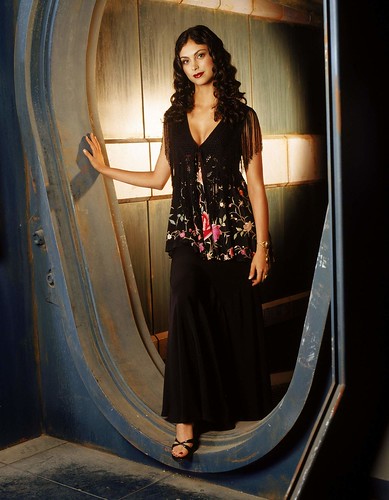
Morena Baccarin is 'Firefly's' classy courtesan Inara Serra.


So far I haven't seen anything too drastic on the new scifi show 'V' (though I have only seen parts of it, so I don't know for sure), but the alien Anna's eerie smile hides plans for world domination.


Summer Glau is 'Firefly's' River Tam, resident brilliant crazy and a potential weapon of mass destruction.

She plays Bennett Halverson, another genius, far more terrifying, psychotic, and sadistic, on Whedon's 'Dollhouse.' (There was a very appropriate picture with the signs "danger" and "caution" behind her.)


And finally, (SPOILER, I guess, even though it's not much of one anymore) Alan Tudyk's 'Firefly' persona is the wise-cracking, vaguely insecure hotshot pilot Wash.

Still funny, but about 1,000x crazier and more violent, Tudyk plays Alpha, a once-wanna-be serial killer who is imprinted with about 40 different entire personalities (not split personalities, though one of them is). This grants him serial killer status, since he now has mad brain power and reflexes. Probably one of the best villains ever. Plus, I guess Tudyk was bad on V along with Baccarin.


I just find this Firefly=evil stuff funny. And cool.