
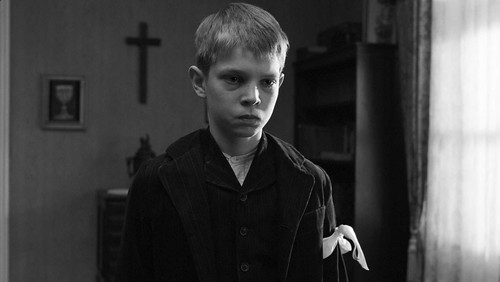
Misfortune and malevolence plague the German village of Eichwald. Its inhabitants are more concerned with local vandalism, maimings, and deaths than the impending Great War. Yet events in the town foreshadow an even deadlier war. Designed to represent innocence, the titular white ribbon actually serves as a punishment for naughty children and raises questions about guilt, pretense, and purity. In The White Ribbon, director Michael Haneke has created a film whose horrors are enveloped in silence and uncertainty, provoking in viewers both thought and terror.
The black and white cinematography conveys the era’s severity and façade of simplicity. There is no music to direct or alleviate tension. Instead, long, sometimes self-conscious, shots develop a sense of dread until evil appears to inhabit every scene. Acting, from the youngest child to the oldest patriarch, is outstanding.
Through the social structures of a claustrophobic town, The White Ribbon examines death, persecution, religion, and vengeance. These far-reaching themes make Eichwald eerily universal.
At the conclusion of the showing I attended, a man whispered, “My God, what a movie.” Grateful for a chance to relieve tension, and perhaps in unspoken accord with the speaker, the audience burst into laughter. Still, an unsettling feeling lingered. And lingered.


