Friday, October 15, 2010

The Social Network


The Social Network is a classical tale of power and revenge. It begins in 2003 at Harvard, where undergraduate Mark Zuckerberg invents the vast social networking website Facebook. Director David Fincher (Fight Club, Se7en) intersperses Mark’s upward trajectory with scenes from two lawsuits against him, one from his friend and co-founder Eduardo Saverin and one from classmates Cameron and Tyler Winklevoss.

Aaron Sorkin, also a playwright, adapted this outstanding script from Ben Mezrich’s mostly true book The Accidental Billionares. Language is as central to this film as it is to any play. Conversations are the equivalent of car chases. In spite of its cleverness, the dialogue remains remarkably natural.

The fast talk is aided by snappy editing and pumping music, which sometimes turns as ominous as the darkly lit Harvard campus. Even glamorized scenes of elite parties are shot in somber tones. Further visual ingenuity is evinced in one scene in which the camera makes the world of a rowing race look like a perfect toyland. This athletic struggle mimics the characters’ overarching business battles.

Impeccably cast, The Social Network is also a fascinating character study. Played by Jesse Eisenberg, Mark’s intelligence and drive dominate the story. So brilliant he occasionally comes across as an evil genius, Mark is lonely, self-centered, and contemptuous. (His outfits consist of hoodies and sandals.) This protagonist’s tragic flaws allow him everything but friendship.

The film is tilted towards Mark’s former friend Eduardo (Andrew Garfield). While his decency and victimization are overemphasized, the character is quite believable and certainly sympathetic.

Also interesting are the amusing Winklevoss twins, played by Armie Hammer (thanks to incredible special effects). Tall and gorgeous, these Olympic class rowers resemble Olympians. They may be entitled, but their plight is understandable.

Even Sean Parker (Justin Timberlake), the creator of Napster and the man who seduces Mark into a larger life, comes across as more pathetic than villainous. Sean has surface charm and appreciates Facebook’s potential, but he is at best unreliable and sophomoric.

Smaller parts are likewise well acted, including Mark’s level headed and thus brief girlfriend (Rooney Mara) and the twins’ furious friend Divya Narendra (Max Minghella). The only misstep is Rashida Jones as a (gorgeous) lawyer who is bizarrely compassionate to Mark, in an apparent attempt to make him more likable.

Certain aspects of the story are sexed up and simplified. Only the exclusive side of Harvard is explored. Most disturbing is that the characters on which The Social Network is based are still alive. Though mixing fact and fiction can be dubious, the creators of the film performed extensive research and invited everyone to give their input. Understandably, Mark Zuckerberg declined to participate.

Fast paced, hilarious, and parabolic, The Social Network will ensnare many into its world of competition and self-destruction. It is an excellent portrayal of Internet and youth culture in all its innovation, imagination, selfishness, and insolence. Amongst questions of class and control, we watch Mark and others chase after a sense of happiness that is ultimately hollow.

Wednesday, September 22, 2010

I Am Love


The intoxicating I Am Love (Io sono l’amore) begins in winter. On a gray Milan day, snow encases the Recchis’ villa. But inside, the abode is glorious and bustling. Emma (Tilda Swinton) works with her servants to prepare a dinner in which her father-in-law (Gabriele Ferzetti) will name the successor to his business. Emma’s beautiful family arrives one by one, and the banquet proceeds.

No one seems to fit more into the Recchis’ immaculate lifestyle than Emma, a Russian transplant. She is close to her children, especially her confiding daughter Elisabetta (Alba Rohrwacher) and oldest son Edoardo (Flavio Parenti). He works for the Recchi business and supports his best friend Antonio’s (Edoardo Gabbriellini) efforts to start a new restaurant. Emma attends Antonio's family restaurant where his cooking affects her like an aphrodisiac.

I Am Love is a hypnotic addition to the oft told story of a woman’s awakening. As the film moves into and through the heights and depths of summer weather, several characters embark on a journey of self discovery and freedom. The dazzling score, featuring many pieces by John Adams, is as much a part of the movie as its imagery. While there are subtle commentaries on character, globalization, and classism, much of the symbolism is obvious. Birds flutter against church ceilings; moths fight against lamp shades. Gourmet food, naked bodies, and edenic scenery are lovingly illuminated.

Because the dialogue is occasionally cliché, I Am Love works best when no explanations are given. Tilda Swinton is superb, and the attractive supporting cast is excellent. Italian director Luca Guadagnino’s highly dramatic film is not for everyone, but some will adore this sweeping symphony of transformation and love.

Monday, August 16, 2010

Winter's Bone


Though Winter’s Bone builds an atmosphere of dread, self-consciousness undermines its resonance.

Ree Dolly (Jennifer Lawrence) lives with her family in the Missouri Ozarks. Her drug dealing father, nowhere to be found, has put up their house and land as collateral for his bail. Ree vows to find him even as she cares for her younger siblings and mentally ill mother. She must face down hostile relatives to get to the truth behind her father’s disappearance and, more importantly, save her home.

Winter’s Bone (an adaptation of Daniel Woodrell’s novel ) feels like a cultural lesson in rural poverty. Close ups accompany tense moments. A shaky camera conveys the area’s rawness. Winter is captured in rare beauty, with its dead leaves, barren trees, and back roads. Scenes of everyday survival (including wood chopping and squirrel hunting) are interspersed with Ree’s search for her father. Unfortunately, the filmmakers’ obvious (but largely successful) attempts at authenticity come across as manipulative. The unusual filmic setting is the foreground, which makes the characters somewhat secondary.

Jennifer Lawrence is excellent as Ree, but her character is difficult to identify with. A youth with troubles beyond anyone’s years is not unrealistic, but Ree is nearly perfect. Unselfish, wise, understanding, tough, and above all determined, Ree is willing to sacrifice everything for her wards, without ever losing her temper with them. She has bouts of insecurity and naïveté, but she is more admirable than interesting.

The acting is quite good, though little liveliness is shown. Characters’ pinched cheeks, chapped lips, and grim faces are realistic, but few leave an impression. In fact the only fascinating presence is Teardrop (John Hawkes), Ree’s coke addicted uncle. Ambiguous and scary but loyal, Teardrop is not someone you want as an enemy.

Overly poetic dialogue jars with the rest of the film’s painstaking attempts at realism. Saintly Ree gives her brother advice such as “don’t ask for what ought to be offered,” and notes that she is a “Dolly, bred and buttered.” Also, Ree’s search gets rather repetitive as she is told by person after person to give up her quest.

Since images of barren trees and a haunting, gorgeous soundtrack evoke an ominous mood from the beginning, any darkness that lies within the community doesn’t come as a shock. More surprising are the displays of genuine kindness. More astonishing still in this gothic tale would have been expressions joy or dynamism.

Saturday, August 7, 2010

The Devastating War Zone


Tom (Freddie Cunliffe) is an adolescent, which means he is as internally tumultuous as Devon’s weather. He and his family have transferred from London to an isolated country house near the sea. His pregnant mother (Tilda Swinton) quietly misses London, but his father (Ray Winstone) and older sister Jessie (Lara Belmont) stay occupied with work and college searches. The family spends their days trudging through rain or cozying up at home. They hardly notice when Tom, already sullen, discovers something that shakes him into near silence.

The War Zone (based on a book by Alexander Stuart) depicts a situation that is theoretically simple and in actuality anything but. Told from the perspective not of a knowing outsider but of innocence as it is being lost, Tim Roth’s directorial debut is uniquely powerful. Its most appalling moments are justified, even crucial.

The camera lingers on small figures surrounded by green and gray and pummeled by the elements. The ocean’s rhythmic violence and the setting’s physical remoteness clearly reflect the family’s emotional trials. The repetitive, sometimes sentimental soundtrack is still effective.

Tom’s impenetrability ultimately works, but Cunliffe’s lack of expressions is off-putting in comparison to Belmont’s harrowing performance as Jessie. Thespians Swinton and Winstone are understated and excellent as the parents. The sparse, mumbled dialogue is naturalistic if occasionally heavy handed (and difficult for Americans to understand).

The film offers no explanations and leaves on an ambiguous note, forcing viewers to identify with its tender protagonists. In spite of its bleak portrayal of youth overwhelmed by confusion, The War Zone has changed lives. Realistic in a way few movies are, its very existence dispels myths, fosters sympathy, and inspires confessions. The film’s flaws do not detract from its rare significance.

Friday, July 23, 2010

Inception


Combine an innovative director, idea, and cast. Add to that a story that questions reality, physics defying fight scenes, and wonderful special effects. What do you get? Unfortunately, with Inception, not much.

Christopher Nolan (The Dark Knight, Memento) directs this complex blockbuster about mental espionage. Using fancy technology, expert thief Cobb (Leonardo DiCaprio) is able to sneak into a subject’s subconscious to steal information. Inception’s plot involves an even more difficult, nigh impossible, assignment: planting an idea. At the behest of the shady Saito (Ken Watanabe), Cobb and his crew plan to give Saito’s economic competitor Fischer (Cillian Murphy) the impulse to dissolve his company. Complicating matters is the projection of Cobb’s dead wife Mal (Marion Cotillard), who violently haunts his every entry into dreamland.

The film is more interested in muddled sequences reminiscent of Tomb Raider than characters. In an attempt to build suspense, scenes move from one shot to another and back ad nauseum.

Nolan’s measured character studies and puzzle-like plots are often superior to his action scenes. But here characters, one of Nolan’s strengths, are subtle to the point of dullness. They come across as mere plot devices. This may be intentional, a metacognitive device, but it doesn’t make our heroes any more interesting.

Slightly unhinged and haunted by a dead wife, Cobb is distractingly reminiscent of DiCaprio’s role in the movie Shutter Island. Cobb’s psychosis isn’t enthralling enough to emotionally anchor the plot. His right hand man Joseph Gordon-Levitt looks smashing but is lifeless. Ellen Page as Ariadne, the dream architect, looks lovely but is likewise uninteresting. Tom Hardy’s Eames is the cheeky but two dimensional “forger” who can change his appearance once in a dream. Watanabe’s Saito is at first mysterious, but ultimately opaque as anyone else. Dileep Rao as Yusuf, the apothecary, is intriguingly amoral – or maybe not; his character is hardly developed. In an unsatisfying part, Murphy, whose subconscious everyone enters, excels. He stands out as the only one who evokes sympathy. Cotillard as the dangerously multifaceted Mal is also excellent.

None of these characters hold many, if any, surprises. In fact, there are few twists in the entire movie , which is bizarre for a Nolan flick. Also unusual for one of his films is a lack of moral exploration. Our protagonists break into someone’s mind. This isn’t really questioned. The cast’s remarkable chemistry makes a lack of humor conspicuous. They all remained so cool, it’s difficult to feel suspense.

Perhaps Inception is difficult “to get.” It’s easy to ask, whose subconscious are they in? How did they get there? Why? What’s at stake? This confusion prevents you from enjoying the film, but the real problem is not caring about the explanation.

Friday, June 25, 2010

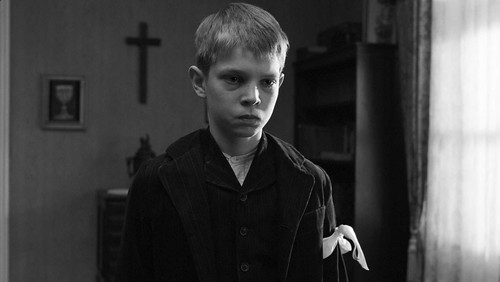
The White Ribbon (Das Weisse Band)


Misfortune and malevolence plague the German village of Eichwald. Its inhabitants are more concerned with local vandalism, maimings, and deaths than the impending Great War. Yet events in the town foreshadow an even deadlier war. Designed to represent innocence, the titular white ribbon actually serves as a punishment for naughty children and raises questions about guilt, pretense, and purity. In The White Ribbon, director Michael Haneke has created a film whose horrors are enveloped in silence and uncertainty, provoking in viewers both thought and terror.
The black and white cinematography conveys the era’s severity and façade of simplicity. There is no music to direct or alleviate tension. Instead, long, sometimes self-conscious, shots develop a sense of dread until evil appears to inhabit every scene. Acting, from the youngest child to the oldest patriarch, is outstanding.
Through the social structures of a claustrophobic town, The White Ribbon examines death, persecution, religion, and vengeance. These far-reaching themes make Eichwald eerily universal.
At the conclusion of the showing I attended, a man whispered, “My God, what a movie.” Grateful for a chance to relieve tension, and perhaps in unspoken accord with the speaker, the audience burst into laughter. Still, an unsettling feeling lingered. And lingered.

Sunday, June 13, 2010

Why I Like 'The Vampire Diaries' (television)

I thought the show would be worse than Twilight. Its setup is identical: a vampire falls in love with a high school girl. To my surprise, The Vampire Diaries kept me tuning in every week.

Our heroine Elena (Nina Dobrev) lives in the historic Virginia town Mystic Falls. Her parents recently died in a car crash, leaving her and her dope-head brother Jeremy (Steve McQueen) in the care of their young aunt Jenna (Sara Canning), a lovable pal but sucky guardian. Elena’s grief causes her to bond with the - unbeknownst to her - nice vampire stalker Stefan (Paul Wesley). Unfortunately, he has a vampire brother who is not so nice. Damon (Ian Somerhalder) enjoys making his brother’s life miserable and has no qualms about eating humans. He also notices that Elena looks exactly like their (yes, their) ex who lived more than a century ago.

Other cast members include Elena’s cute ex Matt (Zach Roerig), his a-hole best friend Tyler (Michael Trevino), and Tyler’s druggie girlfriend Vicki (Kayla Ewell). She is also Matt’s sister and Jeremy’s love. The town is incestuous. Then there are Elena’s best friends Bonnie (Katerina Graham) and Caroline (Candice Accola). Bonnie is sweet and supportive; Caroline is blond and bitchy.
It’s… Believable
For a cheesy show about gorgeous townsfolk and creatures of the night, it’s surprisingly realistic. (Note: I am used to television-hot actors not CW-hot. These people look like no one I've met.) The most initially stereotypical characters turn out to be some of the most complex.

It’s Funny
The Vampire Diaries doesn’t take itself too seriously. The heroine’s best friend matter-of-factly explains why she is psychic. They laugh at such a preposterous notion. (So does the audience, for other reasons, of course.) One vampire advises another: “You’re dead, dude. Get over it.”
It’s Surprising
Even though the series borrows heavily from previous vampire/teen stories, it follows its own path. It uses and plays with formulas. The pilot features Elena running through a foggy graveyard, complete with an ominous crow. It also quickly dissolves a budding love triangle cliché because a character actually acts sensibly.

It’s Consistent
They’ve done a darn good job with the vampire mythology. The explanations, including questions of vampire morality, have a basic logic. Not only that, but the tone, pacing, and character development are dependable. Unlike many shows, actions (usually) have consequences. Characters have motivations and don’t forget about what they did the previous week.
The vampire “look” is perhaps the best I’ve seen. When vamps get blood hungry they sprout fangs. Eyes become bloodshot and veiny. These immortal serial killers are scary twists on their human selves, beastlike and vicious.

The writing and acting are respectable. Nina Dobrev can be grating in a teenager-y way, but her Elena is an appealing character. Paul Wesley is somewhat one note, but he brings a wisdom and tenderness to the role of Stefan. That he manages to be less than creepy is a remarkable feat which alone elevates the show far above Twilight. Ian Somerhalder clearly relishes playing Damon, who is funny, flirtatious, and wicked, but perhaps not irredeemable.

Certain scenes are ridiculous and unintentionally hilarious, but the camp is part of the fun. Due to historical echoes, intertwining relationships, and flashbacks to the brothers’ vampire births, the show borders on epic. How can you not enjoy a show where vampires play high school football, embarrass history teachers, and attend Halloween parties dressed as – you guessed it – vampires?