Monday, September 17, 2012

Metropolitan follows the self-absorbed and well-intended

Allison Parisi as Jane and Edward Clements as Tom


Whit Stillman’s singular wit is on fine display in Metropolitan, his first and perhaps most famous film. Some viewers might not want to follow upper crust (or “UC,” as one character says) New Yorkers who dine, dance, and complain about their privilege. Others will delight in their alternately ridiculous and thought-provoking dialogue.

One Christmas vacation, Tom Townsend (Edward Clements) stumbles into a crowd of socialites. He knows several of them, but his situation is decidedly middle class. Tom claims he doesn’t approve of their decadent balls, yet night after night he partakes in their soirees and late night discussions


These youths are prone to hyperbole and contradiction. One calls Tom “the phony of the decade,” while another calls a peer “one of the worst guys of modern times.” They don’t think twice about dismissing Charles Fourier’s utopian socialism. Initially obnoxious, their pretension becomes increasingly amusing and even poignant as they try to justify their existence. The awkward Charlie Black (Taylor Nichols) breathlessly goes on about how their class is doomed. They have nowhere to go but down. What else are they to do but enjoy themselves and philosophize?

Along with the conflicted Tom and confusing Charlie, this group includes Cynthia McLean (Isabel Gillies), the “slut,” Audrey Rouget (Carolyn Farina), the book lover, and the often passed-out Fred Nuff (Bryan Leder. They usually gather at homes of the sophisticated Sally Fowler (Dylan Hundley) or imperious Jane Clark (Allison Parisi).


The most memorable individual is Nick Smith, played by Christopher Eigeman. Like an Oscar Wilde character but with more conviction, Nick revels in defending the status quo and has an opinion on everything. Hypocritical, wise, passionate, dishonest—Tom says, “he’s basically a nice guy, I think.” Others believe Nick “could be really crazy.” He vilifies the titled Rick Von Sloneker (Will Kempe), his apparent nemesis. Is this slander, or is Nick just more observant than the others? Nick might drive his friends crazy, but in a moment of crisis (real or imagined), they note that Nick “would know what to do.”

There are moments of pathos. Several characters harbor painful crushes, and both Nick and Tom come from “broken homes.” Nick uses humor to describe his step-mother’s malice, while Tom is in denial of his father’s indifference.
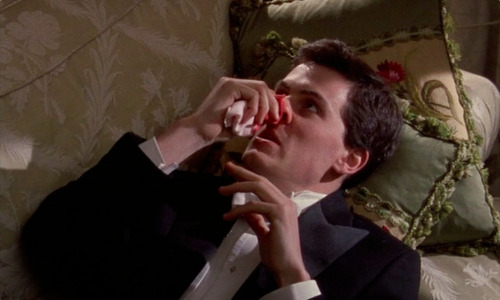
Christopher Eigeman as Nick

The cinematography is simple, and the music is appropriately whimsical. Because there is no plot, Stillman’s films can feel interminable. Eigeman is always spot on, but some of the young actors, most of them appearing in film for the first time, are rather wooden and awkward.

Still, this window into the lives of the self-absorbed and youthful rich contains great humor. While their manner of speaking may be unrecognizable to most audiences, these people are surprising in a way fictional characters rarely are. Only comparable to other Stillman personalities, Nick is a unique figure in cinema, as is Whit Stillman himself. 

Monday, September 10, 2012

Lockout

Our heroes, Guy Pearce and Maggie Grace.
The gleefully bad Lockout is determined to have a retro look and feel. The film aspires to be a politically incorrect and formulaic B-movie. There is no need to rack your brain over its plot holes. The simple story takes place in the future, when almost everything is dimly lit. While by no means a good film, Lockout is still somewhat entertaining.

While investigating the conditions of a space prison (yes, a prison in space), the president's daughter Emilie (Maggie Grace) finds herself in the middle of a breakout. Officials send "Snow" (Guy Pearce), who is on his way to jail or worse after being framed for murder. At least one convict (Joseph Gilgun, clearly having a good time) is inexplicably obsessed with Emilie after spending a few minutes talking to her. Vincent Regan adds a little gravitas as the criminal ringleader Alex, but he, like the rest of these characters, is undeveloped.

Predictably, Snow and Emilie clash. Snow is sarcastic and tough as nails, as well as disrespectful and whiny. He is not particularly likable, but he is funny and has an edge. In the face of certain death, Emilie finds it strangely necessary to try to get to know him. Her character doesn't make sense, but at least she shows a little gumption and compassion. (Grace's expressions are somewhat puzzling, though, since she looks as though she's trying not to laugh through most of the film. Or perhaps she's just unable to hide her attraction to Snow?)

Snow treats her pretty roughly in the name of getting in and out, but their tension is one of the best things about the movie. Much of the acting is quite bad, including Peter Stormare's as the man who insists Snow's guilty. Lennie James is decent as a coworker supposedly on Snow's side, though he, along with everyone else, doesn't really seem to care about the potential deaths of hundreds. The end appears to be a half-baked afterthought, but a lot here is. Sitll, if you want to watch a movie late at night that doesn't take itself too seriously, Lockout isn't necessarily a bad choice.

Milk does a body good. One of our villains, Joseph Gilgun.

Friday, September 7, 2012

Lawless

Tom Hardy as Forrest Bondurant


Lawless is an entertaining but uneven adaptation of Matt Bondurant’s novel The Wettest County in the World, which was inspired by the author’s grandfather. Part gangster flick, part Southern gothic, and part Western, the story follows the three Bondurant brothers in Prohibition era Virginia. They are reputed for their survival skills and good moonshine. Local authorities don’t care. The oldest two brothers don’t think twice about beating aggressors with bare fists or brass knuckles. The youngest is eager but more of a lover than a fighter.

Occasionally, a gangster might stray into town to commit murder or a gang might try to rob the brothers. Otherwise, all goes smoothly until a lawman from Chicago swoops in and wants a cut. Denied this, he wages war against all bootleggers in the county, including the intrepid Bondurants.
Jason Clarke as Howard Bondurant

The atmospheric beginning captures the hard boiled life of our heroes in all its browns, from beards and clothes to ramshackle buildings. The detailed depiction is both accurate and the archetype of a mountain town in the early twentieth century: expect strong accents and tobacco spit (and blatant WHITES ONLY and COLORED signs, in case you forgot people were racist then). The evocative soundtrack is gorgeous if occasionally heavy handed. Landscapes are equally memorable, from a smoky mountainside to a kudzu covered wonderland.

This film takes its time in introducing its enjoyable characters before it veers off course. The acting is excellent. A surprisingly funny Tom Hardy plays Forrest Bondurant, the occasionally tender hearted but tough as nails ringleader. Jason Clarke does well with less as the haunted, constantly drunk Howard Bondurant. Shia LaBeouf is effective as Jack, the baby. Ambitious and foolish, the endearing Jack tries to swagger, but he generally reacts to violence the way most of us would—with pure terror.
The Bondurant brothers.

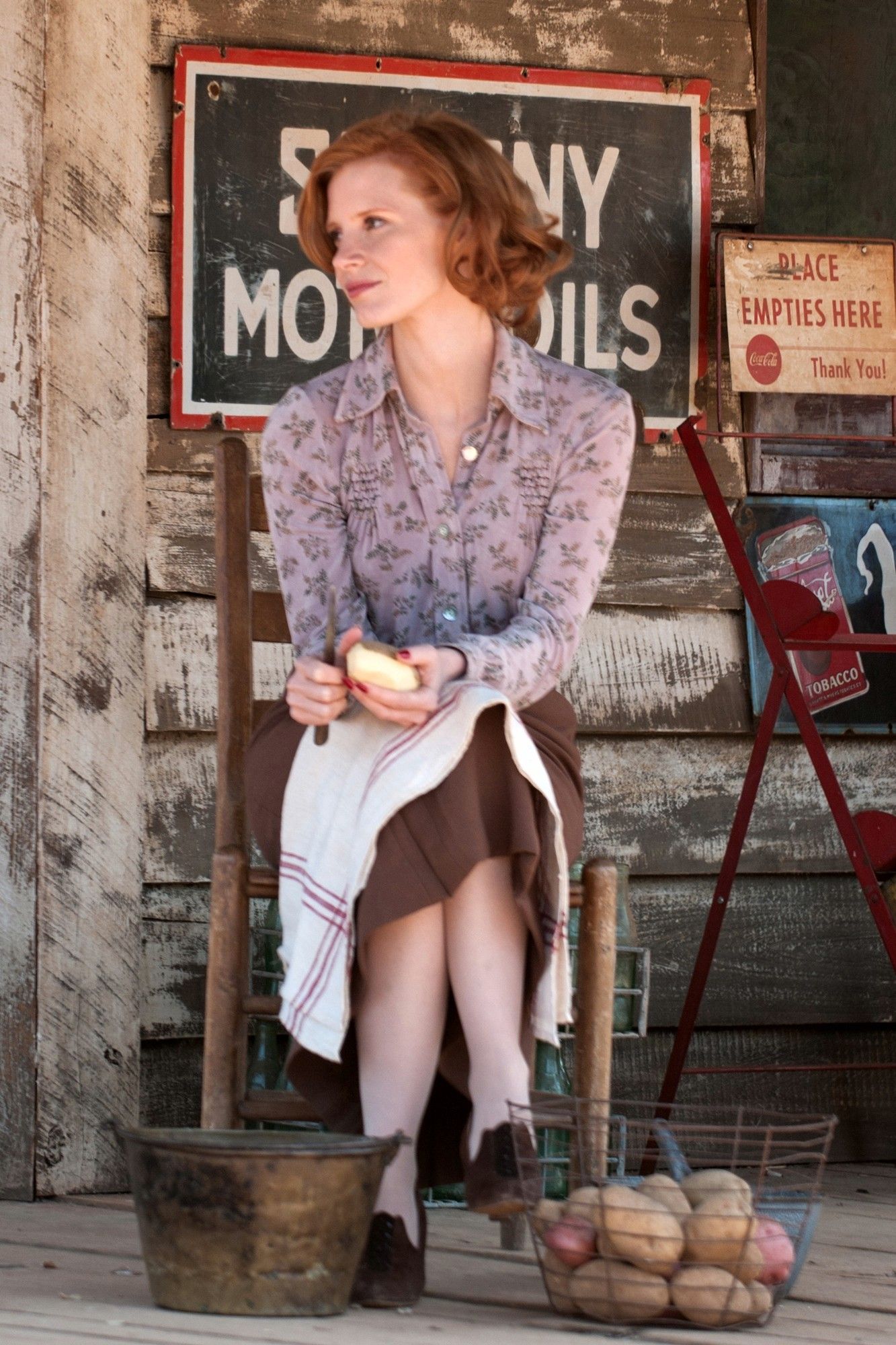
Jessica Chastain has little to do but look concerned and lovely like many women in Westerns, but Mia Wasikowska has a little more meat as the unattainable preacher’s daughter who catches Jack’s eye. She enjoys flirting with the love-struck, unsuitable Bondurant boy; her sly coquetry is highly believable. Dane DeHaan plays Jack’s sweet, innovative friend, and their relationship is predictable but convincing in its innocence.

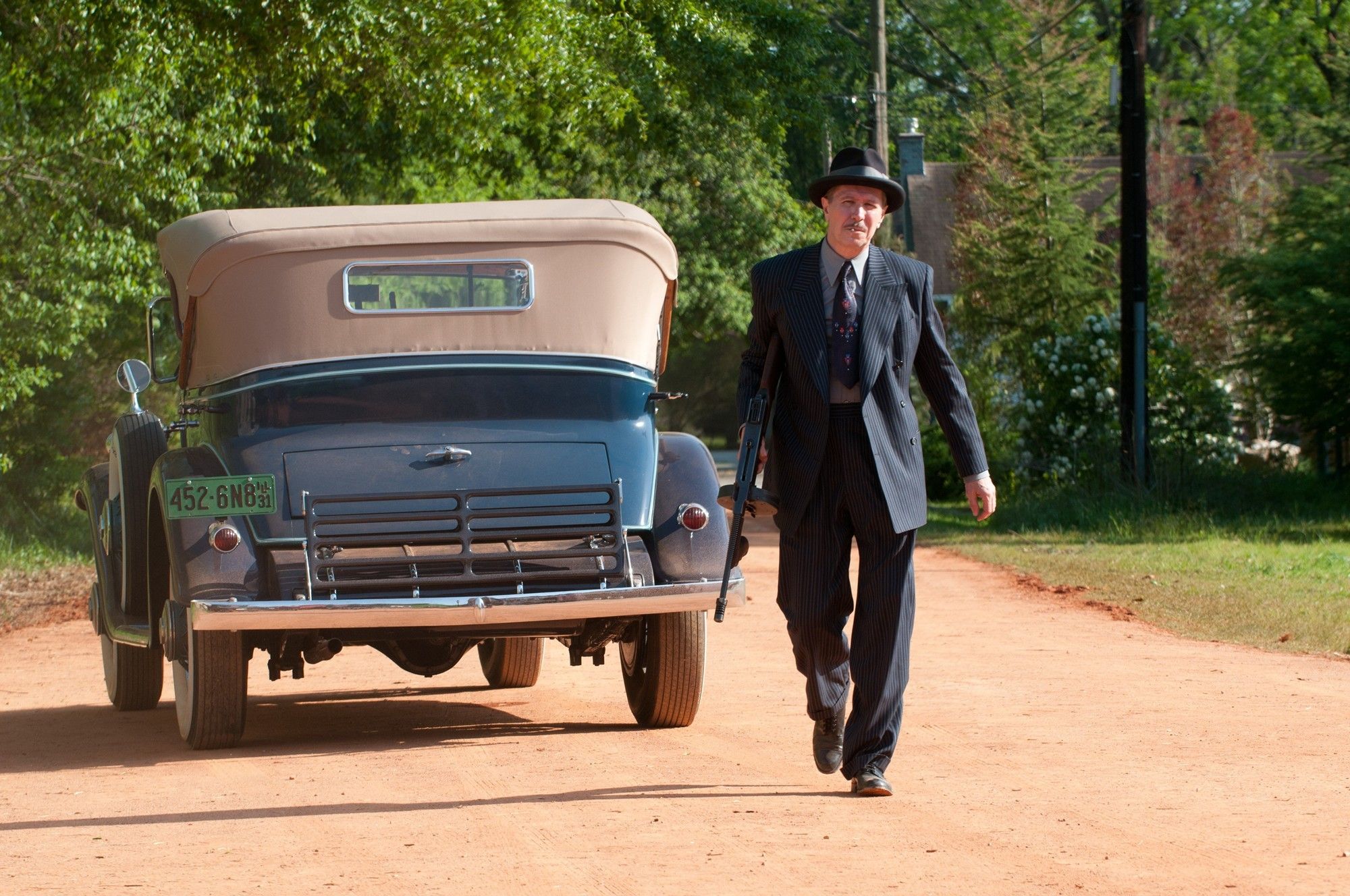
Gary Oldman has a small role as a notorious gangster, and Guy Pearce plays Special Agent Charlie Rakes. Pearce is amusing but not exactly subtle. For example, when introduced, he walks up to the first woman he sees and leers at her for several minutes. He openly laughs in the faces of these “hicks,” as he calls them.  (The audience gasped whenever he unexpectedly appeared and cheered when he sustained injuries.)
Guy Pearce as Charlie Rakes

As disturbing as Rakes can be, his villainy is somewhat diminished since the protagonists are as brutal as he is. Rakes may abuse innocents while the Bondurants torture murderers, but it’s difficult to get behind characters who mutilate people. The villain’s crimes are portrayed as sadistic and traumatic, while the main characters’ violence is often shown to be grim but funny and deserved.

The violence itself is extremely graphic but not always serious. The Bondurants are rumored to be “indestructible,” so don’t be surprised if characters recover remarkably quickly from life-threatening wounds. The theme of immortality is successfully played for laughs, but it could have been a statement about the Bondurants’ reckless youth and egomania.
Shia LaBeouf and Mia Wasikowska

An amalgamation of genres gives the film a unique feel, and a few surprises await viewers. But the story also contains numerous clichés that don’t serve the plot. One fears for the safety of a good natured but physically disabled character, and several women are raped because… they are women? At least one of the sexual assaults is shown off screen but does nothing to forward the plot or the victim’s arch. The act is hardly addressed, but then again, little of the violence here is.

The movie’s tone is simultaneously too lighthearted and too dark. Grisly though it is, Lawless is still a fun and well-acted film. It’s unfortunate that the movie doesn’t reach its promised intensity, reducing what could have been a rousing legend into a diverting yarn.
Shia LaBeouf as Jack Bondurant

Monday, September 3, 2012

Beasts of the Southern Wild


"Beasts of the Southern Wild" tries not to romanticize the heroine’s wild world of poverty and primal freedom. The six year old Hushpuppy lives in the Bathtub, a bayou community that lives off the grid. Trained by her father Wink to be self-sufficient, they live separately, surviving off of fish and a livestock, including chickens, goats, and pigs. The alcoholic, occasionally abusive Wink sometimes disappears for days on end, and Hushpuppy misses her long absent mother.

Still, like many children, Hushpuppy loves her father and revels in the Bathtub’s independence. She is told they are better off than those in the “civilized” world. The jubilant opening scenes feature unconstrained revelry. These citizens would rather live and die on their own terms than submit to the regulations of modern life. The plot itself involves melting icecaps, ancient creatures, and a tremendous storm.


Quvenzhané Wallis plays the adorable, strong, and sympathetic Hushpuppy. Her performance is perhaps the film’s greatest asset.  The rest of the actors are also excellent, including Dwight Henry as her father. Few films examine a messy father-daughter relationship, in which anger and love go side by side. Very few focus on characters who aren’t white and upper-middle class.

There are several very funny moments and imaginative scenes of whimsy. Hushuppy’s quiet yearning for a mother figure and the sense of community spirit powerfully pervade the film. Though sometimes distracting, the soundtrack conveys a sense of wonder. The beautiful environment is shot mostly with a shaky camera. (Why does destitution often call for a shaky camera?)


However, the film’s loyalties ultimately lie too obviously with the poor and rough heroes. The difference between their world and that of most American moviegoers is demonstrated in a scene in which they gleefully escape from a sterile, prison-like hospital to the bright colors of the Delta. In one troubling sequence, the Bathtub dwellers blow up a levy to reset nature’s equilibrium. How many people did this act kill? The film never addresses this.

The characters express a typical New Orleanian desire to expel sadness with celebration. But, as tough as their lives are, is repression really the best way to live? The idea of dying before being beholden to others is a very American ideal. But "Beasts" doesn’t address the more dangerous, long-term aspects of isolating children from the rest of society, teaching them to fear and loathe the outside world. Hushpuppy’s father has flashes of violence, but this plays into another stereotype about poverty: disadvantaged people tend to be violent.


Many viewers will either ignore or admire these undertones. This is understandable, as the movie is a coming of age tale rather than a political statement. As such, the movie is an original fantasy. But some will find the movie’s messages uncomfortable and ultimately unfulfilling.


Tuesday, August 14, 2012

Open Window


Open Window looks like a made-for-television film,but it tackles a traumatic event with relative nuance. Soon after a professor Peter (Joel Edgerton) proposes to his photographer girlfriend Izzy (Robin Tunney), she is raped by an intruder. Izzy slips into depression and gradually exposes the truth to friends and family. The movie is unusual in that it tracks the reactions of those around her, showing that they, too, are in a kind of shock. Even the best friends misread the situation or don't know what to say.


The script is also ambitious in its exploration of how a violation can bring up past griefs. We see both Izzy's and Peter's strained relationships with their parents and catch glimpses of their professional lives. Robin Tunney is very believable, and Joel Edgerton gives a relatively sensitive performance. Unfortunately, Izzy's obnoxious mother (Cybill Shepherd) comes across as a caricature, though she eventually reveals hidden layers. Izzy's father (Elliott Gould) is more kindhearted but rather lackluster. Several awkwardly acted scenes are further dulled by the bland cinematography. I won't even ask how the young couple can afford such remarkable housing.


The film might have an air of mediocrity, and it doesn't exactly punch you in the gut. Nonetheless, it is an improvement over, for example, David Schwimmer's supposedly true to life film Trust (2010) which busts myths about sexual assault with remarkable heavy-handedness. Open Window is an unexpectedly subtle and realistic portrayal of the complicated recovery after a terrifying attack.

Sunday, August 12, 2012

Acolytes


The terrible film Acolytes could have been a disturbing, claustrophobic thriller. Its intriguing premise features three troubled teens, a threatening assailant, and a cleverer, more malevolent presence. While the opening sequence features the cliché “girl running through forest from pursuer,” its lovely color scheme, jolting edits, and surreal pacing suggest a more affective film than what follows. The audience then encounters three teenagers who skip school and smoke weed. It is unclear why Chasely (Hanna Mangan-Lawrence) prefers the mouthy James (Joshua Payne) to their friend Mark (Sebastian Gregory). Perhaps the confusion arises from the fact that these characters are poorly realized and dully acted. Chasely spends the film staring blankly into space as she listens to music (the movie has a strong indie soundtrack), screaming and crying when the occasion arises (she is a girl, after all), and looking sexy. James is obnoxious and callous, and Mark, our ostensible protagonist, might be the most uninteresting of the lot. They stumble upon a body and wonder if it is connected to Gary Parker (Michael Dorman), a young ex-con who attacked them when they were kids.


One minute characters freak out at some horrific development, the next they are inexplicably composed, speaking in their usual, expressionless voices. The highlight of the film, other than its beautiful, high-contrast cinematography, is Joel Edgerton’s calm serial killer Ian Wright. His physical appearance is entirely unimaginative (how many movies feature psychos who wear glasses, tuck in their shirts, and sport bland expressions?), but we see flashes of intelligence and habitual sadism. Because this murderer is more interesting than the three leads, any connection with or threat he poses to them drums up little suspense. The ostensibly intense conclusion contains a jarring shock that makes no sense. The film’s potential is ruined by a narrative that is beyond jumbled, tediously paced, and unconvincingly acted.


Tuesday, January 24, 2012

Tinker Tailor Soldier Spy


The spies in Tomas Alfredson’s artfully crafted adaptation of John Le Carre’s 1974 novel Tinker Tailor Soldier Spy toil away in mundane offices. Most of what they type and read is a mystery. When suspicions of a mole arise, former spy George Smiley is called in as suddenly as he was forced to retire. Throughout the film, one wonders not only about the mole’s identity but about where these spies’ work begins and their emotional lives end.


Though hours shorter than the 1979 BBC adaptation, this version takes its time. The movie, like the book, often forces the audience to read between the lines. Its color scheme is as bleak as the story’s Cold War setting, and the camera almost nostalgically observes the drudgery of sorting through physical files and writing with pen and paper. The soundtrack and slower pacing mimic movies of the 1970s, but the cinematography and editing are simultaneously inventive and retro.

This very believable world is peopled with chilly characters, played by an excellent array of familiar actors. Each is tinged with suspicion and a hint (or more) of amorality. Beneath even the more demonstrative personalities lie opaque motivations. John Hurt plays the paranoid and cantankerous Control, head of the Circus (the ring of top spies). Toby Jones does well as Percy Alleline, an ambitious spy who gets in a power struggle with Control. Toby Esterhase, a Hungarian working for England, is played convincingly by David Dencik, and Colin Firth perfectly fits the charming Roy Bland.

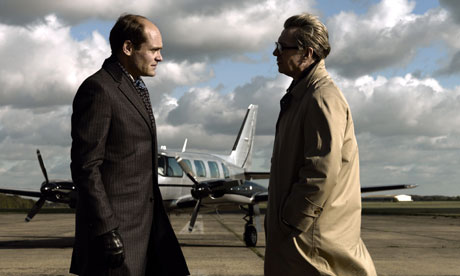
Mark Strong’s portrayal of a haunted “Scalphunter” is especially poignant, as is Tom Hardy’s disturbed Ricky Tarr. Also memorable are Simon McBurney as the bureaucratic but shrewd British undersecretary and Benedict Cumberbatch, touching as Smiley’s young assistant Peter Guillam. Gary Oldman plays our unlikely hero, Smiley. For the first half of the film, he hardly says anything. His dull and humble appearance is impossible to read. But his low voice contains a glimmer of cunning. Gradually Smiley’s skills of perception and methodical tactics show results. While unassuming and vulnerable, Smiley is also unnaturally calm, and aware of when to use either sympathy or implacability to get the intelligence he needs.

A few common phrases (such as “bad apple,” and “trust no one”) pepper the script, but clichés are extremely rare. Don’t expect these characters to explain why they sacrifice their relationships and moral codes for a tedious job that is both dangerous and thankless. Some likely appreciate the sordid fruits of their labor; others might relish the gathering of information. The older ones hang onto past glories of World War II. Some may not know.

The plot jumps between characters and time periods. It is not always clear who is looking for what and why. Yet this confusion adds to the complexity that makes up the world of spies and secrets. The story is confusing, but the sense of alienation that lurks behind the Circus’s jokes and jaunty boys’ club mentality is all too certain.