Showing posts with label movie review. Show all posts

Monday, November 18, 2013

The Hobbit: An Unexpected Journey


The second part of Peter Jackson's The Hobbit trilogy will arrive in about one month, so I am revisiting my experience watching the first movie in the theatre. An Unexpected Journey is entertaining but bloated and frustratingly familiar. 

The story follows Bilbo Baggins (Martin Freeman) years before his younger cousin Frodo's adventures in The Lord of the Rings. Gandalf (Ian McKellen), Frodo's mentor, drops by one day to take Bilbo on an adventure. More than a dozen dwarves join them in an attempt to reclaim their treasure and homeland from a greedy dragon. Jackson doesn't just follow J.R.R. Tolkien's book The Hobbit. He adds tidbits from other Tolkien books to flesh out the story.

The film's ambiance is jarring, alternately somber and colorfully childish. The latter is the more endearing, mainly because it is more original. Many shots and scenes come across as a worn imitation of The Lord of the Rings trilogy. Action scenes are repetitive and confusing, while other scenes drag on. Cutting a good 45 minutes might have improved the pacing.

That said, revisiting Tolkien's work is nostalgic. Its ominous tone, including a glimpse of the dark "necromancer," foreshadows the increasing perils in The Lord of the Rings. The characters are charming. Bilbo is more mischievous and developed than the movie-version's saintly Frodo (Elijah Wood). (It is still nice to see Frodo again.) The dwarves, though stereotypes, including Richard Armitage's Thorin, are nicely acted and likable.

There is something enjoyable about talking monsters. Their humor SLIGHTLY humanizes them. Unfortunately, a white, giant orc is given a very cheesy role as Thorin's nemesis. The film dwells far too long on how evil this creature is. We had three movies to discover how bad orcs are. I didn't find this plotline compelling.

Perhaps the best scene of the film occurs between Bilbo and (SPOILER ALERT) Gollum (Andy Serkis). It is one of the most subtle moments in a loud, heavy-handed movie. The encounter between the former hobbit-like creature, a currently mad Gollum, and the inexperienced but crafty hobbit Bilbo is genuinely suspenseful.

The cinematography and music are lovely, but all derivative. It feels more like a copy than an ode. The Hobbit could have been a truly resonant, enchanting movie instead of a trilogy. The makers could have distinguished this film from its predecessors. But the lure of gold, as Smaug the dragon would agree, is strong enough to justify one movie for the price of three.

Thursday, April 11, 2013

Reservoir Dogs


I only recently saw Quentin Tarantino's first film Reservoir Dogs. More focused than most of his movies (but by no means a tight narrative, this being Tarantino), Dogs follows a group of criminals. The story slowly unfolds, using flashbacks to tell the audience important--or just diverting--information. All we know for sure is that a heist went terribly wrong. 

The men only know one another's code names. The shrewd (or paranoid) Mr. Pink (Steve Buscemi) suspects there was a betrayal, but Mr. White (Harvey Keitel) lives by an older creed, and finds it difficult to imagine that any of the men he worked with are less than "honorable." Mr. Orange (Tim Roth) has been shot and will bleed to death if he doesn't get medical attention. The rest have either died or scattered. 

Needless to say, the movie includes trademark graphic violence, artful cinematography, and moments of pathos. Scenes are long and self-conscious, full of dialogue both relevant and random. The recognizable cast fit their roles perfectly, from Michael Madsen as the crazy Mr. Blonde to Chris Penn as Nice Guy Eddie, son of big shot Joe Cabot (Lawrence Tierney). While they are all varying degrees of lowlifes, make no mistake, they have no problem murdering policemen or people who get in their way. Yet several appear to hold genuine, even tragic, affection for another comrade.

Reservoir Dogs is recommended viewing for Tarantino fans and one of his funniest and most emotional pieces.

Saturday, December 29, 2012

Queen of Versailles


Lauren Greenfield's masterful documentary The Queen of Versailles follows billionaire David Siegel and his beautiful wife Jacqueline into the great recession. They live in Florida where nannies tend to their eight children, one of whom they "inherited." While in the middle of building the largest house in the United States (inspired by Versailles), the economic crisis hits. David's timeshare empire, the biggest in the world, faces severe cutbacks.

Few tears are shed. The Siegels can be hilariously clueless and outrageous, but they also share moments of regret and generosity. As monetary woes sink in, the excess which was a source of pride for the couple becomes a garish nightmare. In spite of her degree in computer engineering, the buxom, botoxed Jackie claims to be in the dark about their financial situation. David becomes consumed with saving his company, often ignoring the rest of his family or lashing out at Jackie, who admits that she is living in a fantasy world. (The movie's apt title recalls Marie Antoinette and her notorious decadence.)

Before the crisis, one of their many children says it best: they never think about money, but they always think about money. The sense of anxiety hanging over the Siegels will be familiar to many Americans, but their opulence will not. David and Jackie blame the banks for lending them too much money, even though David's cutthroat Westgate Resorts dangles the American Dream in front of people who likely can't afford it.

This well-edited movie interviews the Siegels, their children, employees, servants, and old friends. We find out that the hired help have the smallest rooms in the house and haven't seen their family in years. They tend to children who, along with the pets, appear to be accessories. When David embarks on a Citizen Cane like quest to rescue his wealth, it's not difficult to conclude that Jackie, and perhaps all women, are also possessions to many men in the moneyed world. Hints at strained or broken family relationships are also telling.

This searing family portrait illuminates both the current state of the country and the effect of money on the psyche. The film doesn't clearly track the trajectory of David's company, but it does display hollow, disturbing, and even repulsive results of great wealth.

Wednesday, December 26, 2012

Horrible Bosses


Horrible Bosses opens with Nick, Dale, and Kurt describing their contentment with their work. Nick (Jason Bateman) works night and day at a high-powered company, Dale feels comfortable as a dental assistant and fiance, and Kurt (Jason Sudeikis) enjoys working for a kindly boss (Donald Sutherland) in a family-like work environment. Unfortunately, Nick's boss Dave (Kevin Spacey) is cruel and manipulative, Dale's boss Julia (Jennifer Anniston) sexually harasses and blackmails him, and Kurt's boss dies only to be replaced by his decadent, moronic, and mean son Bobby (Colin Farrell). They decide that, due to their bosses' destructive and deceitful natures, their best option is to kill one another's employers.

The talented cast never quite gels due to thinly drawn characters. Bateman is especially good as his usual deadpan self, but Day's edgy naturalism and occasional ham only reminds one of his much funnier television show It's Always Sunny in Philadelphia. Sudeikis's Kurt is fairly likable, yet his character is just another example of how the average guy can get any model to fall in bed with him.

The idea that workers submit themselves to bad conditions in an economy is touched upon here, as is the fact that men can be sexually harassed (though the situation is played for laughs). Horrible Bosses had potential but didn't tickle my funny bone.

Monday, December 24, 2012

Argo


Argo is a good film. It has the kind of tight direction Ben Affleck can handle with ease, but it is also too tidy. Based on a true story about a CIA operation during the Iran hostage crisis, the film hits all the right notes. It features edgy camerawork, period detail, and tense moments. The opening voiceover explains the history and sources of anti-American sentiment without downplaying the destructive state of the revolution.

If you are interested in a mostly unknown stint in which a CIA agent posed as a filmmaker, check it out. Prepare to recognize a host of faces. Still, the movie feels a bit pat. Some of Argo's scenes are intercut to build tension, yet they also feel a tad predictable and manipulative. In spite of its searing place in history, I didn't find Argo particularly memorable.

Saturday, October 27, 2012

2 Days in New York


Julie Delpy's disappointing sequel to 2 Days in Paris finds its French heroine Marion in a happy relationship with Mingus (Chris Rock). They each have a child by an ex (in Marion's case, it is from her boyfriend in 2 Days in Paris). But their relationship is almost destroyed when Marion's father, exhibitionist sister, and her sister's boyfriend (also a distant ex) visit.

The acting is good. There area a few humorous cameos. Delpy is an appealing presence, and Rock is inherently clever. There is some touching commentary on the subtle ways in which Marion's family deals with the recent loss of her mother. Mingus has an amusing relationship with a cardboard cutout of Barack Obama.

Unfortunately, the film mostly goes for tired stereotypes and predictable gags. The French visitors are mostly pro-Obama, but they make some awkward racial comments. The men leer at the women in a large yoga class. Mingus is sometimes baffled by the French arguments. This cultural clash was already explored more humorously and thoroughly in the previous film, so these moments feel like a rehash.

Other parts are surreal and creative, but often more bizarre than funny. One can't blame Delpy for experimenting. Hopefully her next film will be more fulfilling.

Thursday, October 25, 2012

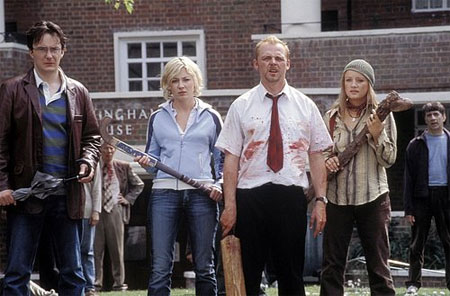
Shaun of the Dead


Edgar Wright's cult classic Shaun of the Dead follows the titular Shaun (Simon Pegg), a nice salesman who feels as though his life is going nowhere. His girlfriend Liz (Kate Ashfield) is disappointed in his lack of ambition. Shaun's best friend Ed (Nick Frost) epitomizes this arrested development. Ed's simian humor (he literally imitates gorillas) amuses Shaun to no end, but leaves their other roommate, Shaun's girlfriend, and her judgmental roommates Diane and Dylan (Lucy Davis and Dylan Moran) cold.

In the midst of his personal problems, Shaun finds himself in the middle of a zombie apocalypse. Is this his chance to find his inner strength and get his life together? That is, if he survives?

This comedy has amusing and surreal moments of silliness and satire, but its humor isn't for everyone. For those whose funny bone it doesn't strike, the film's strength comes from its metaphors. Shaun feels stuck in his routines, held back and a little dead inside--not unlike a zombie. In fact, the drones populating the city of London already resemble the living dead. Shaun is so oblivious to his fellow humans and the world around him, he hardly realizes an epidemic is upon them.


Our hero's journey from overlooked "loser" to courageous leader is also satisfying. He finds himself torn between the well-intended but prepubescent friend of his youth and his girlfriend's affections. This is as much a relationship film as it is a horror movie.

There are some bloody moments, though. Horror and horror-spoof fans will enjoy watching the nonplussed Shaun and his best mate battle zombies. Others might find the film diverting but not particularly memorable. Many might connect to a man in his thirties who is trying to find himself--zombie infestation or no.

Tuesday, October 23, 2012

Citizen Gangster


Citizen Gangster follows real-life figure Edwin Boyd (Scott Speedman) as he transitions from bus driver to theatrical bank robber. A World War II veteran, Edwin struggles to support his wife Doreen (Kelly Reilly) and two children, and dreams of being an actor. One day, he dons makeup and robs a bank at gunpoint. He realizes that, aided by his athletic abilities, this is easy money. Not to mention, he gains the thrill of attention he's always wanted.

In spite of his short-lived joy, the film's bleak colors convey Edwin's depressing, increasingly desperate situation. Unfortunately, the audience never quite connects the rather passive, mild mannered man to his wilder counterpart. The movie also depicts the robberies as more surreal, bemusing, and exciting than harmful, perhaps in order to convey how the media romanticized Boyd's crimes.

The story touches on Edwin's relationship with his father (Brian Cox), a retired policeman, but their complex history is not fully explored. Partway through the film, Kevin Durand brightens the screen as fellow bank robber and veteran Lenny Jackson. Unlike his mostly forgettable criminal friends, Lenny shows believable volatility and unexpected heart. Though not one to be messed with, he latches onto Edwin like a brother. The genuine bond between Edwin and Lenny is one of the most successful aspects of the film.

Their descent into living above the law is not glamorized. Boyd's relationship with his wife is increasingly strained, and the affect his actions have on his family is painful to watch. Still, though well made, the biopic Citizen Gangster never becomes more than the sum of its parts.

Saturday, October 6, 2012

The 24th Day


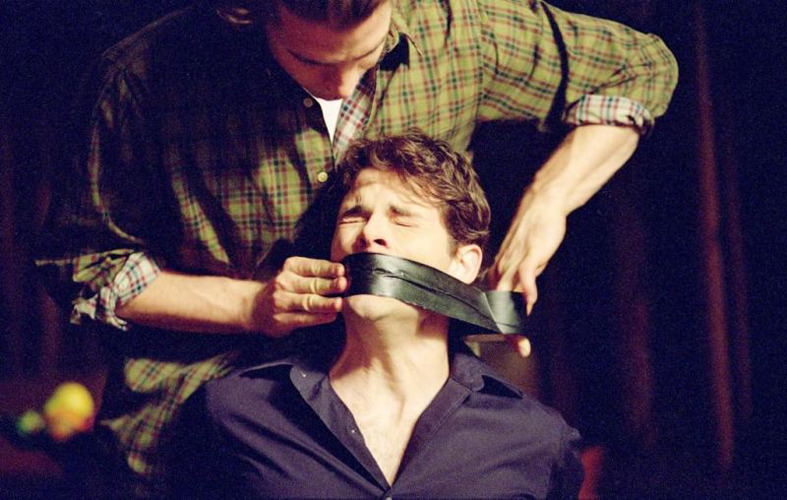
The 24th Day follows two men who meet at a bar. One follows the other home, ready for a night of fun, but the other has different ideas. James Marsden plays Dan, a confident movie executive. Scott Speedman is Tom, who is a cook. Directed by and based on a play by Tony Piccirillo, the script wavers between genuinely interesting and over-the-top, as the relationship between Dan and Tom is alternately believable and unrealistic.


The acting is not bad, but it is rather overshadowed by the soap-opera-level production values. Awkward editing, dramatic music, and cryptic flashbacks yank the viewer out of the genuinely tense apartment scenes. The most interesting aspect of the film is the interaction between Dan and Tom. Their characters bring up questions about class differences, honesty, guilt, and denial. And AIDS, and responsibility, and sexual orientation. Dan can be remarkably calm and sassy, while the sad Tom is so obviously unbalanced one wonders why Dan sticks around at first. While this is ultimately a rather poor movie, one has to admire it for trying.

Wednesday, October 3, 2012

The Moth Diaries


Based a novel by Rachel Klein, Mary Harron's The Moth Diaries never reaches its potential. The plot follows Rebecca (Sarah Bolger) to an all-girls boarding school. She feels that she is turning over a new leaf two years after the suicide of her father, a respected poet. Her bosom buddy Lucie (Sarah Gadon) considers herself boring, but Rebecca sees Lucie as the light at the end of her tunnel. Unfortunately, the enigmatic Ernessa (Lily Cole) arrives, driving a wedge between the two.


A lot is going on here. As their English teacher Mr. Davies (Scott Speedman) schools them on Dracula and homoerotic vampire stories, one can't help but remember that Lucy was Dracula's doomed victim. Is Ernessa metaphorically sucking the life out of Lucie? Is Ernessa literally a vampire? Or is this all in Rebecca's troubled mind? Why do Ernessa and Rebecca share so many similarities? Why does Ernessa tempt Rebecca with thoughts of suicide? Why is Mr. Davies, who admires Rebecca's late father, so interested in the sixteen-year-old Rebecca? Why is Rebecca afraid of sex--is it fear of adolescence, lesbianism, or something more sinister?


These are all intriguing questions, but none are resolved. Instead of lending an unsettling ambiguity to the story, this reduces the movie's emotional impact. Perhaps the biggest problem is the film's tone. Though there is some lovely imagery, the editing, music, and cinematography feel more like a generic teen flick than a haunting psychological thriller. The three main actresses have an ethereal beauty and do their best with what they have. Yet most of the cast lack gravitas. Then again, the fault may lie more with the movie's atmosphere than its actors.


Bolger is especially effective in her emotional scenes but doesn't hint at her potential insanity. Cole is the most effective of the girls as the elegant Ernessa. Her imposing height offsets her sweet, childlike face. She is the mysterious friend who plays the piano, speaks German, and writes poetry more beautifully than anyone else. Speedman is fine as Davies, but one wonders why the school's first male professor is young, attractive, and prone to discussing the power of female sexuality.


This was a great opportunity for a resonant and dark coming-of-age story. In spite of a few otherworldly moments, The Moth Diaries doesn't satisfyingly tie up any of its loose ends, leaving the viewer more confused than haunted.


Saturday, September 29, 2012

What's Your Number?


In spite of its mixed messages about female sexuality, What’s Your Number is surprisingly funny and even touching. Anna Farris plays Ally who hopes to find a date to her sister Daisy’s (Ari Graynor) wedding. After reading that most women who have twenty or more sexual partners never settle down, she is determined that her next lay be “the one.” To prevent raising the number of men she’s slept with, Ally enlists the help of her philandering neighbor Colin (Chris Evans) to track down her exes hoping they improved with time.

One of the film’s problems is its unintentional similarities to the superior Bridesmaids. The heroine has mixed feelings about a wedding, meets a man who encourages her to follow her artistic sensibilities, and struggles with unemployment. (“Struggles” is an overstatement; considering their financial situations, these characters have remarkable apartments.) Even the opening scene contains a gag that is nearly identical to one in Bridesmaids.

Still, the movie is more irreverent and amusing than most romantic comedies. Farris is hilarious as Ally, a young woman who makes many mistakes but never runs out of optimism. Evans is fairly appealing as Colin, the obligatory rogue with a heart of gold. Since he admits that he can hardly spend time with a woman without trying to sleep with her, she doesn’t consider him an option. Instead, she rendezvous with an assortment of ex-boyfriends and flings, played by a pleasing array of actors. A large part of the movie’s appeal consists of her awkward interactions with men played by familiar faces such as Joel McHale, Chris Pratt, Zachary Quinto, Martin Freeman, and Anthony Mackie.


The film also focuses on Ally’s relationship with her family. She feels out of place with her more conventional sister and perfectly coiffed mother, in spite of their close relationships. All this, of course, channels towards her inevitable lesson about love and being herself. Many women will identify with her grapples with relationship advice, the media, and questions about a “normal” modern woman’s sexual appetites. The movie touches on the thin line between giving someone a chance and trying to force a relationship.

Unfortunately, the movie undermines some of its more progressive themes. It certainly includes sexist stereotypes, not to mention weightism. Ally is meant to be a disaster, but she often looks perfect and is shot sexually. (To be fair, Colin is naked throughout most of the movie.) When it comes down to it, though Ally doesn’t fit into the film world, she is still a man’s ideal woman. She isn’t high maintenance, enjoys watching and playing sports (in one scene, she engages in a sexy one-on-one basketball game—in her underwear), and is up for almost anything.

There are definitely moments where the film crosses the line into poor taste. The whole thing is difficult to take seriously. The “comedic” music makes the movie feel as though it should have a laugh track. But What’s Your Number ultimately conveys the “life is messy: embrace it” message with (mostly) good-natured humor.


Friday, September 21, 2012

Wish You Were Here


Kieran Darcy-Smith's Wish You Were Here opens with a whirlwind tour of Cambodia. Four Australian tourists experience the local culture as they would an amusement park. Are they naive and entitled or just adventurous and free-spirited? Whatever the case, only three of them return home. Steph (Teresa Palmer) agonizes over the disappearance of her boyfriend Jeremy (Antony King). His absence hangs over Steph's sister Alice (Felicity Price) and her husband Dave (Joel Edgerton).


Alice must deal with this mystery as she teaches, cares for two children, and carries a third child inside. Price is generally excellent as the mostly contained Alice. She is the center of the film. King is likable if low-key as Jeremy, the mysterious businessman. Palmer's Steph is pretty but self-centered. Edgerton is painfully believable as the traumatized and increasingly erratic Dave. Tender moments with Dave and Alice's adorable and observant children as well as most character interactions are quite realistic.


Because of the story's non-chronological narrative, the plot feels a little thin. Too much depends on reveals, making many scenes more puzzling than intriguing. The audience sees characters react to events that are explained late in the film. This reduces the impact of the actors' work through much of the movie. The film also has several cliches about the "exotic third-world country." Dangerous natives, friendly children, and bright colors are all on display here. There is some subtle lampooning of these travelers, who are as dutifully somber visiting a memorial as they are gleeful when buying overpriced trinkets.


The camera attempts to convey a sense of realism while capturing a peaceful beauty that contrasts with the characters' internal lives. The soundtrack is lively and fitting, especially the haunting closing song "Bend With Me." Though Wish You Were here is a credible and sometimes harrowing psychological study, it leaves the viewer wanting something more.

Monday, September 10, 2012

Lockout

Our heroes, Guy Pearce and Maggie Grace.
The gleefully bad Lockout is determined to have a retro look and feel. The film aspires to be a politically incorrect and formulaic B-movie. There is no need to rack your brain over its plot holes. The simple story takes place in the future, when almost everything is dimly lit. While by no means a good film, Lockout is still somewhat entertaining.

While investigating the conditions of a space prison (yes, a prison in space), the president's daughter Emilie (Maggie Grace) finds herself in the middle of a breakout. Officials send "Snow" (Guy Pearce), who is on his way to jail or worse after being framed for murder. At least one convict (Joseph Gilgun, clearly having a good time) is inexplicably obsessed with Emilie after spending a few minutes talking to her. Vincent Regan adds a little gravitas as the criminal ringleader Alex, but he, like the rest of these characters, is undeveloped.

Predictably, Snow and Emilie clash. Snow is sarcastic and tough as nails, as well as disrespectful and whiny. He is not particularly likable, but he is funny and has an edge. In the face of certain death, Emilie finds it strangely necessary to try to get to know him. Her character doesn't make sense, but at least she shows a little gumption and compassion. (Grace's expressions are somewhat puzzling, though, since she looks as though she's trying not to laugh through most of the film. Or perhaps she's just unable to hide her attraction to Snow?)

Snow treats her pretty roughly in the name of getting in and out, but their tension is one of the best things about the movie. Much of the acting is quite bad, including Peter Stormare's as the man who insists Snow's guilty. Lennie James is decent as a coworker supposedly on Snow's side, though he, along with everyone else, doesn't really seem to care about the potential deaths of hundreds. The end appears to be a half-baked afterthought, but a lot here is. Sitll, if you want to watch a movie late at night that doesn't take itself too seriously, Lockout isn't necessarily a bad choice.

Milk does a body good. One of our villains, Joseph Gilgun.

Friday, September 7, 2012

Lawless

Tom Hardy as Forrest Bondurant


Lawless is an entertaining but uneven adaptation of Matt Bondurant’s novel The Wettest County in the World, which was inspired by the author’s grandfather. Part gangster flick, part Southern gothic, and part Western, the story follows the three Bondurant brothers in Prohibition era Virginia. They are reputed for their survival skills and good moonshine. Local authorities don’t care. The oldest two brothers don’t think twice about beating aggressors with bare fists or brass knuckles. The youngest is eager but more of a lover than a fighter.

Occasionally, a gangster might stray into town to commit murder or a gang might try to rob the brothers. Otherwise, all goes smoothly until a lawman from Chicago swoops in and wants a cut. Denied this, he wages war against all bootleggers in the county, including the intrepid Bondurants.
Jason Clarke as Howard Bondurant

The atmospheric beginning captures the hard boiled life of our heroes in all its browns, from beards and clothes to ramshackle buildings. The detailed depiction is both accurate and the archetype of a mountain town in the early twentieth century: expect strong accents and tobacco spit (and blatant WHITES ONLY and COLORED signs, in case you forgot people were racist then). The evocative soundtrack is gorgeous if occasionally heavy handed. Landscapes are equally memorable, from a smoky mountainside to a kudzu covered wonderland.

This film takes its time in introducing its enjoyable characters before it veers off course. The acting is excellent. A surprisingly funny Tom Hardy plays Forrest Bondurant, the occasionally tender hearted but tough as nails ringleader. Jason Clarke does well with less as the haunted, constantly drunk Howard Bondurant. Shia LaBeouf is effective as Jack, the baby. Ambitious and foolish, the endearing Jack tries to swagger, but he generally reacts to violence the way most of us would—with pure terror.
The Bondurant brothers.

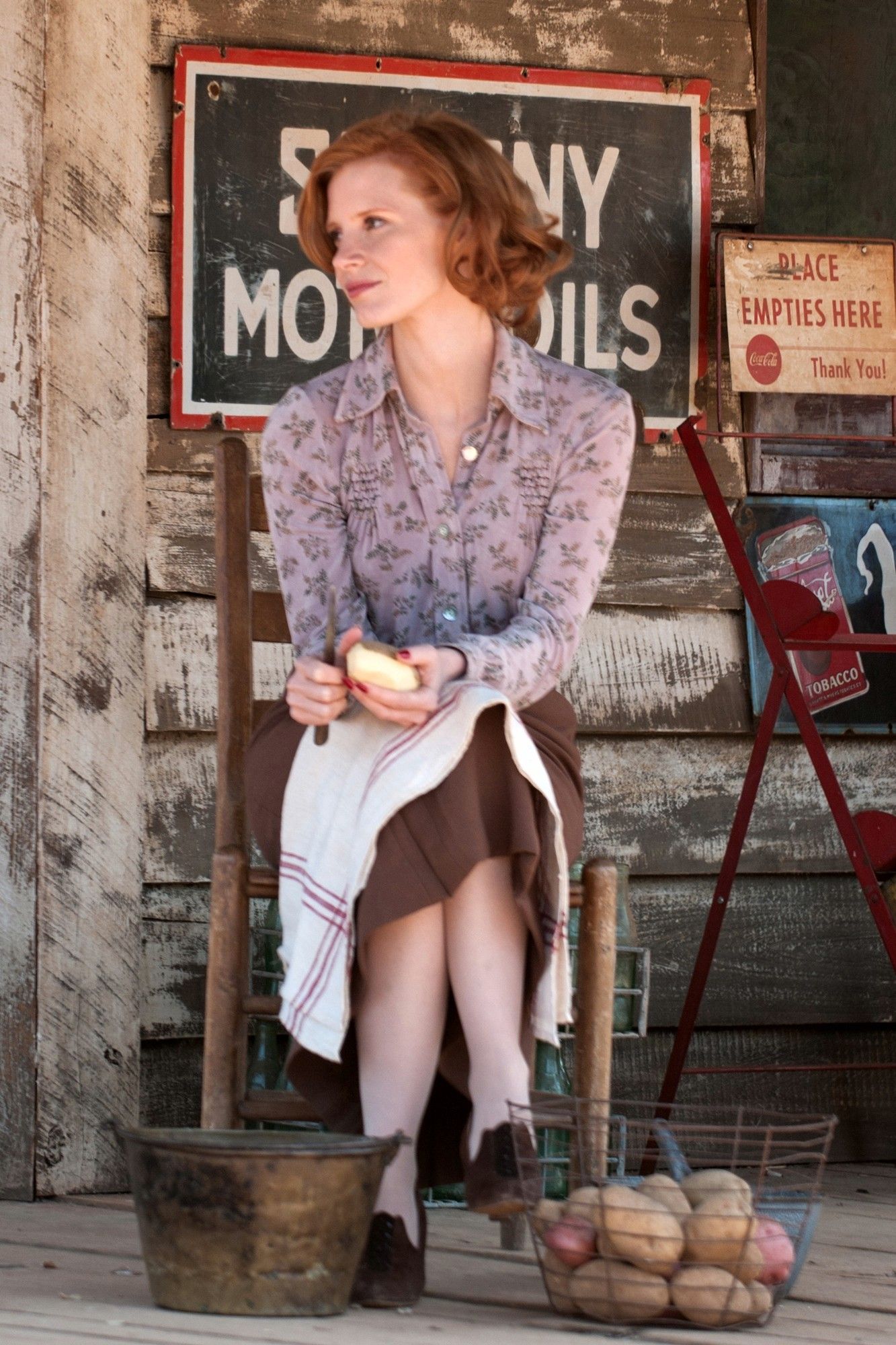
Jessica Chastain has little to do but look concerned and lovely like many women in Westerns, but Mia Wasikowska has a little more meat as the unattainable preacher’s daughter who catches Jack’s eye. She enjoys flirting with the love-struck, unsuitable Bondurant boy; her sly coquetry is highly believable. Dane DeHaan plays Jack’s sweet, innovative friend, and their relationship is predictable but convincing in its innocence.

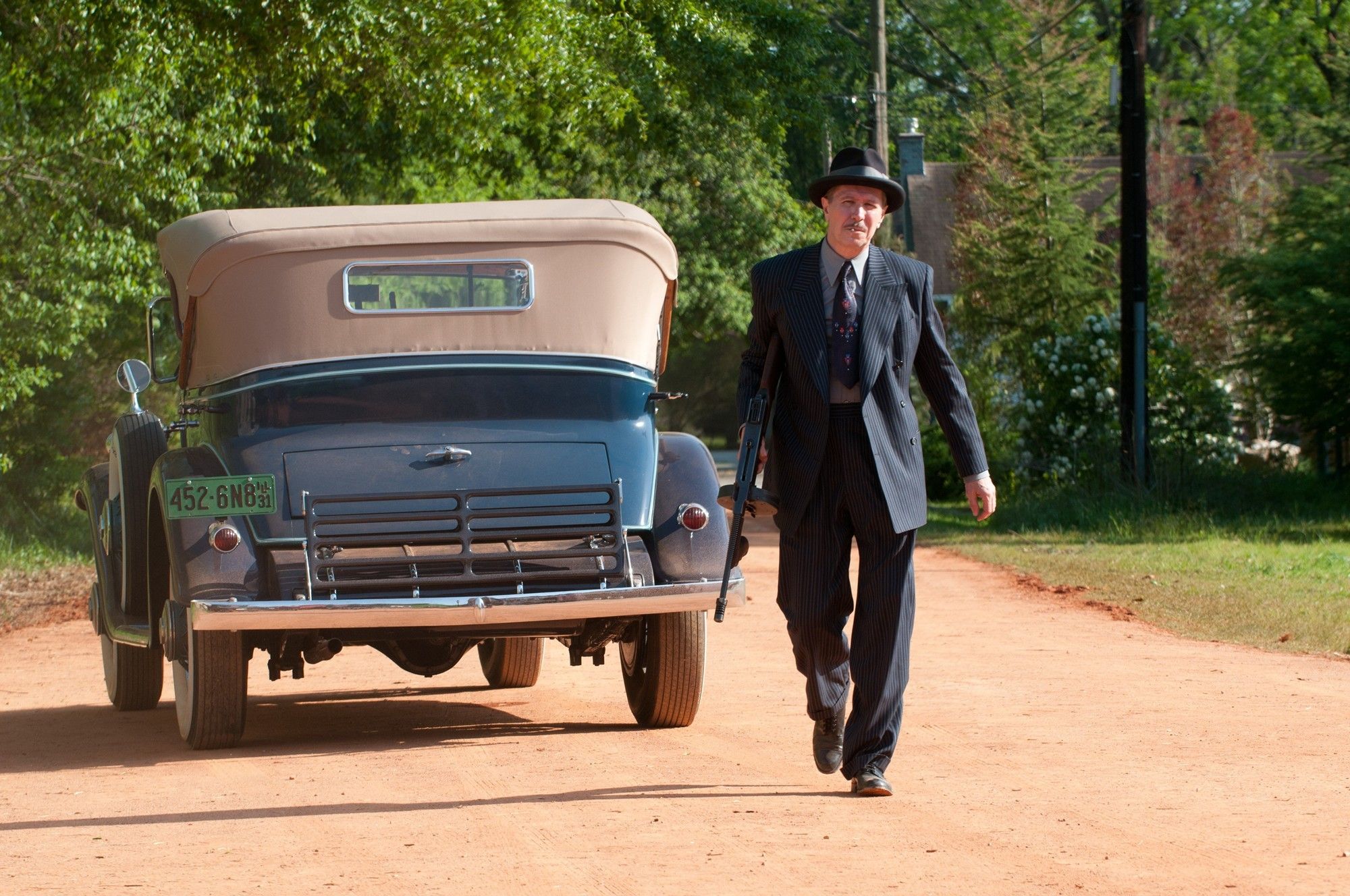
Gary Oldman has a small role as a notorious gangster, and Guy Pearce plays Special Agent Charlie Rakes. Pearce is amusing but not exactly subtle. For example, when introduced, he walks up to the first woman he sees and leers at her for several minutes. He openly laughs in the faces of these “hicks,” as he calls them.  (The audience gasped whenever he unexpectedly appeared and cheered when he sustained injuries.)
Guy Pearce as Charlie Rakes

As disturbing as Rakes can be, his villainy is somewhat diminished since the protagonists are as brutal as he is. Rakes may abuse innocents while the Bondurants torture murderers, but it’s difficult to get behind characters who mutilate people. The villain’s crimes are portrayed as sadistic and traumatic, while the main characters’ violence is often shown to be grim but funny and deserved.

The violence itself is extremely graphic but not always serious. The Bondurants are rumored to be “indestructible,” so don’t be surprised if characters recover remarkably quickly from life-threatening wounds. The theme of immortality is successfully played for laughs, but it could have been a statement about the Bondurants’ reckless youth and egomania.
Shia LaBeouf and Mia Wasikowska

An amalgamation of genres gives the film a unique feel, and a few surprises await viewers. But the story also contains numerous clichés that don’t serve the plot. One fears for the safety of a good natured but physically disabled character, and several women are raped because… they are women? At least one of the sexual assaults is shown off screen but does nothing to forward the plot or the victim’s arch. The act is hardly addressed, but then again, little of the violence here is.

The movie’s tone is simultaneously too lighthearted and too dark. Grisly though it is, Lawless is still a fun and well-acted film. It’s unfortunate that the movie doesn’t reach its promised intensity, reducing what could have been a rousing legend into a diverting yarn.
Shia LaBeouf as Jack Bondurant

Tuesday, August 14, 2012

Open Window


Open Window looks like a made-for-television film,but it tackles a traumatic event with relative nuance. Soon after a professor Peter (Joel Edgerton) proposes to his photographer girlfriend Izzy (Robin Tunney), she is raped by an intruder. Izzy slips into depression and gradually exposes the truth to friends and family. The movie is unusual in that it tracks the reactions of those around her, showing that they, too, are in a kind of shock. Even the best friends misread the situation or don't know what to say.


The script is also ambitious in its exploration of how a violation can bring up past griefs. We see both Izzy's and Peter's strained relationships with their parents and catch glimpses of their professional lives. Robin Tunney is very believable, and Joel Edgerton gives a relatively sensitive performance. Unfortunately, Izzy's obnoxious mother (Cybill Shepherd) comes across as a caricature, though she eventually reveals hidden layers. Izzy's father (Elliott Gould) is more kindhearted but rather lackluster. Several awkwardly acted scenes are further dulled by the bland cinematography. I won't even ask how the young couple can afford such remarkable housing.


The film might have an air of mediocrity, and it doesn't exactly punch you in the gut. Nonetheless, it is an improvement over, for example, David Schwimmer's supposedly true to life film Trust (2010) which busts myths about sexual assault with remarkable heavy-handedness. Open Window is an unexpectedly subtle and realistic portrayal of the complicated recovery after a terrifying attack.

Sunday, August 12, 2012

Acolytes


The terrible film Acolytes could have been a disturbing, claustrophobic thriller. Its intriguing premise features three troubled teens, a threatening assailant, and a cleverer, more malevolent presence. While the opening sequence features the cliché “girl running through forest from pursuer,” its lovely color scheme, jolting edits, and surreal pacing suggest a more affective film than what follows. The audience then encounters three teenagers who skip school and smoke weed. It is unclear why Chasely (Hanna Mangan-Lawrence) prefers the mouthy James (Joshua Payne) to their friend Mark (Sebastian Gregory). Perhaps the confusion arises from the fact that these characters are poorly realized and dully acted. Chasely spends the film staring blankly into space as she listens to music (the movie has a strong indie soundtrack), screaming and crying when the occasion arises (she is a girl, after all), and looking sexy. James is obnoxious and callous, and Mark, our ostensible protagonist, might be the most uninteresting of the lot. They stumble upon a body and wonder if it is connected to Gary Parker (Michael Dorman), a young ex-con who attacked them when they were kids.


One minute characters freak out at some horrific development, the next they are inexplicably composed, speaking in their usual, expressionless voices. The highlight of the film, other than its beautiful, high-contrast cinematography, is Joel Edgerton’s calm serial killer Ian Wright. His physical appearance is entirely unimaginative (how many movies feature psychos who wear glasses, tuck in their shirts, and sport bland expressions?), but we see flashes of intelligence and habitual sadism. Because this murderer is more interesting than the three leads, any connection with or threat he poses to them drums up little suspense. The ostensibly intense conclusion contains a jarring shock that makes no sense. The film’s potential is ruined by a narrative that is beyond jumbled, tediously paced, and unconvincingly acted.


Thursday, January 12, 2012

The Girl with the Dragon Tattoo: Part 2, Fincher Version


As far as I was concerned, my ticket to David Fincher's The Girl With the Dragon Tattoo was paid for as soon as the opening credits rolled. After an awkward cold open in which two old men share one line of dialog, Trent Reznor and Karen O’s cover of Led Zeppelin’s Immigrant Song breaks the quiet mood. While Karen screams about those Scandinavians “from the land of ice and snow,” silvery images of breaking faces, bleeding technology, unfurling flowers, fire, and who knows what else rip across the screen.

Based on the first book in the Swedish Stieg Larsson’s trilogy, The Girl with the Dragon Tattoo follows journalist Mikael Blomkvist (Daniel Craig) and computer hacker Lisbeth Salander (Rooney Mara). Henrik Vanger (Christopher Plummer), the former head of the grand Vanger enterprises, lures Blomkvist to a small town on an island in order to solve the mystery of his long lost niece. Because she disappeared during a family reunion, at a time when an accident blocked off access to the island, Vanger is convinced a relative murdered her. Meanwhile, the audience also follows Salander, a punkish young woman who is under the care of the state for violent behavior. We witness her abuse, her ruthless, methodical reaction to said abuse, and her genius with a computer.


The film manages to overcome one of my biggest pet peeves: characters in a foreign country speak English with a foreign accent. (Why bother? They’re supposed to be speaking another language anyway. The whole world doesn’t revolve around English.) The mostly British and American cast tend to speak with a slight Swedish lilt. Another problem with the movie is a certain violent scene which lingers on the perpetrator’s sadism, seemingly in order to justify retaliation.

Reznor and Atticus Ross’s ambient soundtrack is sometimes self-conscious, as are the sharp editing and Jeff Cronenweth’s striking cinematography. However, this approach works: it infuses the film with suspense, conveys the book’s intensity, and turns moments which could have been difficult to translate from the page into resonant scenes.


Steven Zaillian’s script has been very well edited, weaving subtle themes about greed, victimization, and xenophobia. In general, the few changes from the book clarify the plot. The screenplay is a surprisingly successful balance of character development, dramatic tension, and satisfying solutions.

Most of the characterizations are intriguing and true to their source. Craig’s believable and sympathetic Blomkvist might be an improvement on the original. Mara depicts the wildly popular Salander’s mixture of detachment, calculation, viciousness, and vulnerability. Plummer’s friendly but cunning Vanger is especially close to Larsson’s description. Other Vanger relatives are played by Stellen Skarsgaard (excellent as Henrik’s amiable nephew), an appropriately cold Geraldine James, and a sensitive Joely Richardson.


Niels Arden Oplev’s 2009 Swedish adaptation of the same novel had the disadvantage of a shorter length (it was cut down from a miniseries) and a smaller budget (I assume). The two stars Michael Nyqvist and Noomi Rapace were fantastic, but the series lacked imagination. Overall Fincher’s version better captures the feel of the book, and in some cases even improves upon it. I would love to see the sequels to this beautifully shot, gripping adaptation.

Tuesday, July 14, 2009

Bruno: Terrifying, Hilarious, and Thought-Provoking

Sacha Baron Cohen's 'Borat' is so loved because it satirizes American culture at its worst and allows audiences in on the jokes of the outrageous main character. But why is its crudeness so hilarious? After seeing 'Bruno', in certain ways more explicit than 'Borat', I understood the appeal more. For one, Bruno's insanity makes people angry and thus unguarded. On top of that, the cringe inducing crudeness appeals to our id, our most extreme selves.

'Bruno' is essentially about a narcissistic, fame-seeking, ignorant, homosexual Austrian. He gets banned from the fashion world of his hometown, dumped by his boyfriend, and moves to L.A., a supposedly far less superficial scene. From there, he fails at pretty much everything - auditions, interviews, and even adoption. However, by his side is Bruno's ever faithful and adoring assistant's assistant - Lutz. Their relationship is a hilarious (and ultimately touching) spin on a sappy romance and is concluded in a ridiculously hilarious scene at a wrestling ring.

I actually felt more comfortable in 'Bruno' than in 'Borat' - not because of the gratuitous (and I mean gratuitous) nudity, bizarre sexual escapades, and numerous cases of disturbing sexual harassment - but because it came across as slightly less mean spirited. Perhaps this is why it received worse reviews; it seems to have revealed less about the ugly American than 'Borat'. Still, 'Bruno' covers a fair amount of ground critiquing celebrity adoption "fads," token peace-promoting songs, and most of all, homophobia.

When Bruno offends unsuspecting citizens, from swingers to Ron Paul, their reactions are often of homophobia. It is certainly understandable why most of these victims would be angry, but they often equate Bruno's insanity to his homosexuality, talking about how they don't want any "queer shit." It is reminiscent of people who hurl racial slurs only if they become furious at someone of another race, though race has absolutely nothing to do with the offense.

On top of that, 'Bruno' proves that heterosexual culture can be as scary as and more aggressive than the perceived homosexual culture. 'Bruno' throws in the face the most preposterous stereotypes anyone could have about the "homosexual lifestyle" that so many fear, hopefully making viewers realize their own stereotypes and fears.

'Bruno' is recommended, though be prepared to cover your eyes and bust a gut laughing.

Thursday, July 9, 2009

Master and Commander (movie)


Below decks are dim, crowded, and dirty. When water and cold air chill sailors to the bone, there is nowhere to seek warmth and comfort. The most fascinating happening on the boat, apart from the evening drinking and singing revelries, is the doctor's meticulous attempts to replace part of a man's skull with a coin. Occasionally, an enemy ship will engage in battle; then the thrills and action will be accompanied by blood and fatalities.

Welcome aboard the Surprise, a British navy ship during the Napoleonic Wars. Peter Weir (Gallipoli, The Truman Show) gives a grim and realistic picture of early 19th century battles and ship life. Russell Crowe (L.A. Confidential, The Insider) plays "Lucky Jack" Aubrey, captain of the Surprise. After attacked by a greater French ship, the Acheron, Aubrey is determined to find and defeat the "Phantom Boat", as it is at first dubbed. However, Aubrey's determination leads to near obsession as he peruses the Acheron (which is also following him) no matter what the odds are.


The sails on the sailing ships are grimy, but still beautiful as they billow in the breeze. The movie itself is gritty but magnificent, and the sets and costumes are all created with exquisite care. Sailors are fairly grubby, the food is unappetizing, and light is faint when lanterns are its only source. The ships themselves are gorgeous, though tiny when compared to the number of men who serve on them.


The scenery is absolutely stunning, even though most of the shots involve simply a ship or two surrounding by water, miles and miles of water. There are a few detours to the Galapagos Islands, which are filmed just as breathtakingly as the other scenes.


Acting is first rate. Crowe is excellent, of course, as the dogged and resolute Captain Jack Aubrey, popular leader of the Surprise. The surgeon, played by Paul Bettany (Dogville, A Beautiful Mind), is another interesting character. He is an intellectual who questions the accepted British hierarchy and sailor superstitions, and is enthralled by natural science. Other characters include a young boy, Max Pirkis, in his first movie role, and an indecisive midshipman, played by Lee Ingleby. Most characters are not elaborated, but they are all believable and serve for some poignant moments.


Dialogue is wonderful, literate, though it could be considered corny at times. The violence can be very grisly, especially in the aftermath of fighting, though the battles themselves are mercifully swift and blurred.


Master and Commander: The Far Side of the World is supported by rousing music. Despite its gore and realism, the movie is entertaining and stirring. Highly recommended, though the queasy may cringe at scenes. Fans of sea tales and adventures of any sort should not miss this.


Minor Quibble: With the extensive attention to every detail in this movie, I wish they could have made the captain and the doctor look like they were actually playing stringed instruments. It could have been worse.