Friday, June 25, 2010

The White Ribbon (Das Weisse Band)


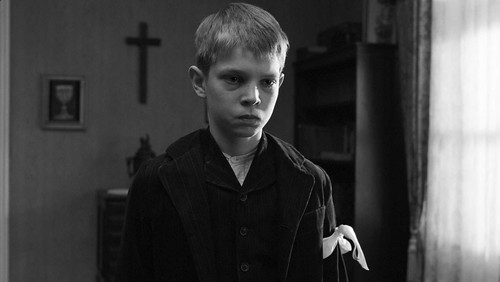
Misfortune and malevolence plague the German village of Eichwald. Its inhabitants are more concerned with local vandalism, maimings, and deaths than the impending Great War. Yet events in the town foreshadow an even deadlier war. Designed to represent innocence, the titular white ribbon actually serves as a punishment for naughty children and raises questions about guilt, pretense, and purity. In The White Ribbon, director Michael Haneke has created a film whose horrors are enveloped in silence and uncertainty, provoking in viewers both thought and terror.
The black and white cinematography conveys the era’s severity and façade of simplicity. There is no music to direct or alleviate tension. Instead, long, sometimes self-conscious, shots develop a sense of dread until evil appears to inhabit every scene. Acting, from the youngest child to the oldest patriarch, is outstanding.
Through the social structures of a claustrophobic town, The White Ribbon examines death, persecution, religion, and vengeance. These far-reaching themes make Eichwald eerily universal.
At the conclusion of the showing I attended, a man whispered, “My God, what a movie.” Grateful for a chance to relieve tension, and perhaps in unspoken accord with the speaker, the audience burst into laughter. Still, an unsettling feeling lingered. And lingered.

Sunday, June 13, 2010

Why I Like 'The Vampire Diaries' (television)

I thought the show would be worse than Twilight. Its setup is identical: a vampire falls in love with a high school girl. To my surprise, The Vampire Diaries kept me tuning in every week.

Our heroine Elena (Nina Dobrev) lives in the historic Virginia town Mystic Falls. Her parents recently died in a car crash, leaving her and her dope-head brother Jeremy (Steve McQueen) in the care of their young aunt Jenna (Sara Canning), a lovable pal but sucky guardian. Elena’s grief causes her to bond with the - unbeknownst to her - nice vampire stalker Stefan (Paul Wesley). Unfortunately, he has a vampire brother who is not so nice. Damon (Ian Somerhalder) enjoys making his brother’s life miserable and has no qualms about eating humans. He also notices that Elena looks exactly like their (yes, their) ex who lived more than a century ago.

Other cast members include Elena’s cute ex Matt (Zach Roerig), his a-hole best friend Tyler (Michael Trevino), and Tyler’s druggie girlfriend Vicki (Kayla Ewell). She is also Matt’s sister and Jeremy’s love. The town is incestuous. Then there are Elena’s best friends Bonnie (Katerina Graham) and Caroline (Candice Accola). Bonnie is sweet and supportive; Caroline is blond and bitchy.
It’s… Believable
For a cheesy show about gorgeous townsfolk and creatures of the night, it’s surprisingly realistic. (Note: I am used to television-hot actors not CW-hot. These people look like no one I've met.) The most initially stereotypical characters turn out to be some of the most complex.

It’s Funny
The Vampire Diaries doesn’t take itself too seriously. The heroine’s best friend matter-of-factly explains why she is psychic. They laugh at such a preposterous notion. (So does the audience, for other reasons, of course.) One vampire advises another: “You’re dead, dude. Get over it.”
It’s Surprising
Even though the series borrows heavily from previous vampire/teen stories, it follows its own path. It uses and plays with formulas. The pilot features Elena running through a foggy graveyard, complete with an ominous crow. It also quickly dissolves a budding love triangle cliché because a character actually acts sensibly.

It’s Consistent
They’ve done a darn good job with the vampire mythology. The explanations, including questions of vampire morality, have a basic logic. Not only that, but the tone, pacing, and character development are dependable. Unlike many shows, actions (usually) have consequences. Characters have motivations and don’t forget about what they did the previous week.
The vampire “look” is perhaps the best I’ve seen. When vamps get blood hungry they sprout fangs. Eyes become bloodshot and veiny. These immortal serial killers are scary twists on their human selves, beastlike and vicious.

The writing and acting are respectable. Nina Dobrev can be grating in a teenager-y way, but her Elena is an appealing character. Paul Wesley is somewhat one note, but he brings a wisdom and tenderness to the role of Stefan. That he manages to be less than creepy is a remarkable feat which alone elevates the show far above Twilight. Ian Somerhalder clearly relishes playing Damon, who is funny, flirtatious, and wicked, but perhaps not irredeemable.

Certain scenes are ridiculous and unintentionally hilarious, but the camp is part of the fun. Due to historical echoes, intertwining relationships, and flashbacks to the brothers’ vampire births, the show borders on epic. How can you not enjoy a show where vampires play high school football, embarrass history teachers, and attend Halloween parties dressed as – you guessed it – vampires?

Monday, May 31, 2010

The O.C. (Television)


You can tell a lot about a show from one episode.

The O.C. (2003-2007) is a high budget teen soap opera set in wealthy Orange County, California. In spite/because of its ridiculousness, this series is very popular. I enjoy mocking bad tv while secretly enjoying it, so I watched (most of) an episode.

Unfortunately, The O.C.’s terribleness baffles rather than amuses me. The choppy editing gives the impression that sections are missing. A boring, poor kid (Ben McKenzie) lives with a nerdy, rich kid (Adam Brody). The rich guy, who is smart because he is “writing a novel,” is codependent on the poor guy. The poor guy is in love with a rich girl (Mischa Barton) who is neither interesting nor believable. Their extremely original courting scenes involve giggling and falling into a pool.

The rich girl and a girlfriend (Rachel Bilson) discuss their fathers’ credit cards. Her girlfriend makes fun of someone for being poor. The rich girl’s ex (or is he?) boyfriend laughs at a poor person. Remember, they are privileged.

Also, you should know that parties with poor people are hardcore because they feature strippers and guns. Because of this, the poor guy has to babysit his rich friend.

Their parents are busy fulfilling other stereotypes. Mothers are bitchy, backstabbing gossips. Fathers are too boring to watch.

There are a few good lines and a few good actors. Most of the time, the writers’ and actors’ attempted manipulations of the audience were painfully evident. TV really IS bad.

Wednesday, May 5, 2010

Inglourious Basterds = The White Ribbon


Some might find the comparison bizarre at best. Quentin Tarantino’s Inglourious Basterds is grim but humorous, an absurd adventure. Michael Haneke’s The White Ribbon is grim and… grim, a stark, subtle horror. (Its moments of charm are overwhelmed with dread.) Still, the two films have certain similarities.

1. Each is close to two and a half hours.
2. Both received negative reviews from the New York Times and Christian Science Monitor (the two newspapers I read most frequently.)
3. Both were at least 10 years in the making. (Mostly in the mind of the director.)
4. Both were directed and written by the same person.
5. Both were nominated for best movie Oscars (best film and best foreign film). Both lost.
6. Both are oversimplified by critics. (Inglourious Basterds is oversimplified by just about everyone, including fans.)
7. Both are in my top [insert number - let's say, fifteen] movies.
And then there are the obvious:

8. Both are set in Europe.
9. Both include German actors speaking lots of German. Yep.
10. Both occur during or before a World War.

There you have it.

Sunday, May 2, 2010

The Plague of Doves, by Louise Erdrich


The Washington Post, Chicago Tribune, San Francisco Chronicle, and Christian Science Monitor named Louise Erdrich’s The Plague of Doves a best book of the year. Narrated by several individuals, her novel spans the history of Pluto, North Dakota and an adjacent Ojibwe reservation. Evelina, a young half-Ojibwe girl, listens to the tales from her grandfather Mooshum. We also hear from Judge Antone Bazil Coutts, who falls in love with Evelina’s aunt, and follow his ancestor and namesake in Pluto’s early existence. Histories intertwine, and the present repeats and contradicts the past.

The Plague of Doves resembles a short story collection, though its chapters are more interconnected and less complete than short stories. Erdrich lovingly details the mannerisms of individuals and wide-sky thunderstorms, but the use of multiple speakers can distance and confuse the reader. Still, moments of brilliance and humor emerge in situations dramatic and mundane. The delightful but flawed Mooshum is a poignant creation. Holy Track is a haunting but underdeveloped figure. One dazzling section is told by the mentally ill Marn Wolde. She is married to the fascinating Billy, a Messianic (or satanic) figure of terrible charisma.

Unfortunately, Marn Wolde’s wild commentary suffers from a lack of clarity, as does almost every segment. Dramatic events affect characters too little or too much, distracting from what is actually unfolding. Stereotypical characters like the heartless, self-righteous Father Cassidy also detract from the story’s power.

Starvation, murders, lynchings, kidnappings, and romances connect in fated coincidences. However, a lack of realism and narrative drive muddies beautiful imagery. Thus the supposed final punch is more hollow than gut wrenching.

Sunday, April 25, 2010

My Name Is Red

The person who recommended Orhan Pamuk’s My Name Is Red confessed that it was one of the most difficult books she had read. It sounded gorgeous: told from different perspectives, including figures in ancient illuminations, a contemplative murder mystery unfolds during the Ottoman Empire’s sixteenth century. The book won the Nobel Prize in Literature, as well as a variety of other awards in multiple languages. The likes of The New York Times Book Review, The New Yorker, Los Angeles Times, and The Economist Reviews cited: “A modern classic,” “a tour de force,” “Astonishing,” “magnificent,” “Shakespearean in its grandeur,” and “demonstrates the patience of … Proust and Mann, [while] his instinctive affinity lies with … Calvino and Borges.”

So instead of getting it from the library, I bought it. I love art and philosophy.

I stopped reading after 75 pages.

The story began from the fascinating viewpoint of a murdered corpse. Yet, my first doubts arose when he cadaver told about the afterlife. Instead of shedding light or adding suspense, the description of life after death merely made me think, “Well, I guess people can make up what they want when it comes to the afterlife.” After several chapters, my illusions that the book was made of interweaving threads fell away. I was reading one story, containing many different stories within it. These tales included lessons that, to me, didn’t seem particularly noteworthy. Even after gleaning the exact same lesson from five different stories.

Any depth of personality eluded me. No character held my interest. The women were objects of wit and desire, and the men were hardly more rounded. Rapists and torturers were described as enlightened and gentle. This may have been an attempt to depict the mindset of individuals at the time. Instead, the vaguely sketched characters are dull.

The translation was also off-putting. Characters speaking in formal settings dropped the f-bomb. Not the foul but the inappropriate language bothered me.

I’m sure that the characters and narration style were meant to imitate illuminations themselves as well as traditional storytelling. I’m also certain that there was a cultural difference that I was unable to overcome.

The person who recommended the book to me said that she had to put the book down for at least a year the first time she picked it up. I will also put it down for at least a year. At least.

Thursday, February 25, 2010

Shutter Island


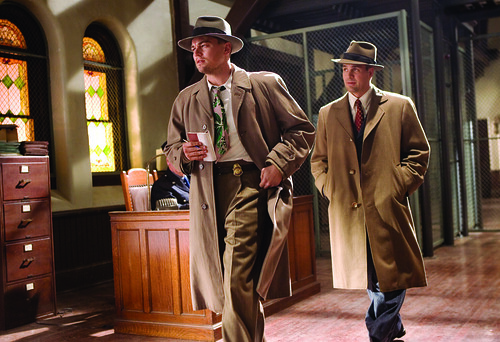
Martin Scorcese's 'Shutter Island' may not be as praised or praiseworthy as his recent film 'The Departed,' but it is nonetheless a successfully tense viewing experience. Leonardo DiCaprio is, as expected (lately), powerful, almost overwhelming, as the tumultuous marshal Teddy Daniels. He has been sent to investigate the disappearance of a woman on an island off Massachusetts that consists solely of a prison for the criminally insane. On the ride over, he meets his new partner Chuck (Mark Ruffalo), and at the institute, he encounters a variety of cryptic doctors and disturbed patients.

Dr. Cawley (Ben Kingsley) appears to be a forward thinking psychiatrist, while the German Dr. Naehring (Max von Sydow) espouses harsher beliefs about the mad. Between unfruitful interviews, Teddy dreams of his dead wife Dolores (Michelle Williams) and recalls the liberation of the Dachau concentration camp, of which the fenced in island is eerily reminiscent. Kingsley and von Sydow are reliably subtle. Emily Mortimer and Patricia Clarkson are likewise excellent in very different roles.


Progressively surreal circumstances make both Teddy and the audience increasingly uncomfortable. The surprisingly straightforward ending has been criticized as cheap and predictable. However, it has enough substance to make the viewer consider seeing the film twice.


Problems include one too many smiles by crazy folks. Instead of creepy, they come across as cliche. Also, though visually astounding, flashbacks and dream sequences lack intriguing dialogue. Per usual in adaptations of Dennis Lehane novels (Gone Baby Gone and Mystic River), the love interest is more a foil to the male protagonist than a fully developed character.


The movie's slow pace resembles the similarly scored Stanley Kubrick classic 'The Shining.' Though 'Shutter Island' doesn't reach those heights, it is good in its own right, especially towards the middle of the piece, when viewers don't know what to think or hold on to.