Tuesday, January 24, 2012

Tinker Tailor Soldier Spy


The spies in Tomas Alfredson’s artfully crafted adaptation of John Le Carre’s 1974 novel Tinker Tailor Soldier Spy toil away in mundane offices. Most of what they type and read is a mystery. When suspicions of a mole arise, former spy George Smiley is called in as suddenly as he was forced to retire. Throughout the film, one wonders not only about the mole’s identity but about where these spies’ work begins and their emotional lives end.


Though hours shorter than the 1979 BBC adaptation, this version takes its time. The movie, like the book, often forces the audience to read between the lines. Its color scheme is as bleak as the story’s Cold War setting, and the camera almost nostalgically observes the drudgery of sorting through physical files and writing with pen and paper. The soundtrack and slower pacing mimic movies of the 1970s, but the cinematography and editing are simultaneously inventive and retro.
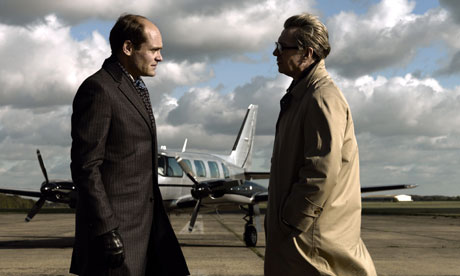
This very believable world is peopled with chilly characters, played by an excellent array of familiar actors. Each is tinged with suspicion and a hint (or more) of amorality. Beneath even the more demonstrative personalities lie opaque motivations. John Hurt plays the paranoid and cantankerous Control, head of the Circus (the ring of top spies). Toby Jones does well as Percy Alleline, an ambitious spy who gets in a power struggle with Control. Toby Esterhase, a Hungarian working for England, is played convincingly by David Dencik, and Colin Firth perfectly fits the charming Roy Bland.

Mark Strong’s portrayal of a haunted “Scalphunter” is especially poignant, as is Tom Hardy’s disturbed Ricky Tarr. Also memorable are Simon McBurney as the bureaucratic but shrewd British undersecretary and Benedict Cumberbatch, touching as Smiley’s young assistant Peter Guillam. Gary Oldman plays our unlikely hero, Smiley. For the first half of the film, he hardly says anything. His dull and humble appearance is impossible to read. But his low voice contains a glimmer of cunning. Gradually Smiley’s skills of perception and methodical tactics show results. While unassuming and vulnerable, Smiley is also unnaturally calm, and aware of when to use either sympathy or implacability to get the intelligence he needs.

A few common phrases (such as “bad apple,” and “trust no one”) pepper the script, but clichés are extremely rare. Don’t expect these characters to explain why they sacrifice their relationships and moral codes for a tedious job that is both dangerous and thankless. Some likely appreciate the sordid fruits of their labor; others might relish the gathering of information. The older ones hang onto past glories of World War II. Some may not know.

The plot jumps between characters and time periods. It is not always clear who is looking for what and why. Yet this confusion adds to the complexity that makes up the world of spies and secrets. The story is confusing, but the sense of alienation that lurks behind the Circus’s jokes and jaunty boys’ club mentality is all too certain.

Thursday, January 12, 2012

The Girl with the Dragon Tattoo: Part 2, Fincher Version


As far as I was concerned, my ticket to David Fincher's The Girl With the Dragon Tattoo was paid for as soon as the opening credits rolled. After an awkward cold open in which two old men share one line of dialog, Trent Reznor and Karen O’s cover of Led Zeppelin’s Immigrant Song breaks the quiet mood. While Karen screams about those Scandinavians “from the land of ice and snow,” silvery images of breaking faces, bleeding technology, unfurling flowers, fire, and who knows what else rip across the screen.

Based on the first book in the Swedish Stieg Larsson’s trilogy, The Girl with the Dragon Tattoo follows journalist Mikael Blomkvist (Daniel Craig) and computer hacker Lisbeth Salander (Rooney Mara). Henrik Vanger (Christopher Plummer), the former head of the grand Vanger enterprises, lures Blomkvist to a small town on an island in order to solve the mystery of his long lost niece. Because she disappeared during a family reunion, at a time when an accident blocked off access to the island, Vanger is convinced a relative murdered her. Meanwhile, the audience also follows Salander, a punkish young woman who is under the care of the state for violent behavior. We witness her abuse, her ruthless, methodical reaction to said abuse, and her genius with a computer.


The film manages to overcome one of my biggest pet peeves: characters in a foreign country speak English with a foreign accent. (Why bother? They’re supposed to be speaking another language anyway. The whole world doesn’t revolve around English.) The mostly British and American cast tend to speak with a slight Swedish lilt. Another problem with the movie is a certain violent scene which lingers on the perpetrator’s sadism, seemingly in order to justify retaliation.

Reznor and Atticus Ross’s ambient soundtrack is sometimes self-conscious, as are the sharp editing and Jeff Cronenweth’s striking cinematography. However, this approach works: it infuses the film with suspense, conveys the book’s intensity, and turns moments which could have been difficult to translate from the page into resonant scenes.


Steven Zaillian’s script has been very well edited, weaving subtle themes about greed, victimization, and xenophobia. In general, the few changes from the book clarify the plot. The screenplay is a surprisingly successful balance of character development, dramatic tension, and satisfying solutions.

Most of the characterizations are intriguing and true to their source. Craig’s believable and sympathetic Blomkvist might be an improvement on the original. Mara depicts the wildly popular Salander’s mixture of detachment, calculation, viciousness, and vulnerability. Plummer’s friendly but cunning Vanger is especially close to Larsson’s description. Other Vanger relatives are played by Stellen Skarsgaard (excellent as Henrik’s amiable nephew), an appropriately cold Geraldine James, and a sensitive Joely Richardson.


Niels Arden Oplev’s 2009 Swedish adaptation of the same novel had the disadvantage of a shorter length (it was cut down from a miniseries) and a smaller budget (I assume). The two stars Michael Nyqvist and Noomi Rapace were fantastic, but the series lacked imagination. Overall Fincher’s version better captures the feel of the book, and in some cases even improves upon it. I would love to see the sequels to this beautifully shot, gripping adaptation.

Sunday, August 21, 2011

My Mother She Killed Me, My Father He Ate Me: Forty New Fairy Tales


Kate Bernheimer’s ambitious brainchild My Mother She Killed Me, My Father He Ate Me is a mostly delightful compilation of fairy-tale-inspired stories. The contributors include authors from Russia and Japan and widely recognizable names such as Joyce Carol Oates and John Updike. Narrative styles are just as varied. Some are simple retellings; others contain only a wisp of the original fairy tale.

Kate Bernheimer and Gregory Maguire set the stage with their introductions. One can simply flip to the back of the book to learn more about the authors or to the table of contents for a list of stories and their origins. Each story has a brief afterward by the authors describing their inspirations. With such care given to selecting talented authors from around the world, it is surprising that no African tales are featured.

A few of these yarns don’t work without knowledge about their sources. Many of these writers milk the graphic grimness of tales for all they are worth, with results both memorable and tedious. Several stories are so disjointed they lose their purpose, and others feel too self-conscious.

On the whole, though, the creativity makes for a fascinating read. Here are a few of the book’s highlights. [Note: I unintentionally tended to lean towards the more realistic stories.]

Francine Prose’s take on “Hansel and Gretel” depicts a young woman’s visit to a wild artist’s Vermont home. This artist is her husband’s ex-girlfriend’s mother.

“The Warm Mouth” by Joyelle McSweeney is a nightmarish interpretation of “The Bremen Town Musicians.” A “mouth” collects diverse items such as dead bodies and road kill. This horrifying tale is reminiscent of a sickening dream.

“Dappelgrim” by Brian Evenson is a simple, Freudian retelling of the original, a dark story about a monstrous horse and its master – or is the horse the master?

“What the Conch Shell Sings When the Body Is Gone” by Katherine Vaz is one of this book’s best. This poignant meditation on marriage, friendship, and life shifts “The Little Mermaid” to the present day by focusing on a couple of cooks who are obsessed with water.

“Pleasure Boating in Lituya Bay” (based on the Italian “Jump into My Sack”) by Jim Shepard may be the jewel in this collection. This searing short story connects the narrator’s detachment from his life to earlier traumas, and his marital tension to the tension in Alaska’s unstable Lituya Bay.

“The Color Master” (Perrault’s “Donkeyskin”) by Aimee Bender is a lighter, more fanciful story about a group whose job is to seek and mix colors for royalty.

“A Case Study of Emergency Room Procedure and Risk Management by Hospital Staff Members in the Urban Facility” by Stacey Richter is an amusing version of “Cinderella” as told in medical records. Here princesses are drug addicts, and evil princes are dealers.

“Psyche’s Dark Night” (Cupid and Psyche) by Francesca Lia Block is a straightforward and romantic tale of an uncertain and aching love between an aspiring actor and a school teacher.

“The First Day of Snow” (“A Kamikakushi Tale”) by Naoko Awa is a short and somewhat mesmerizing tale about a girl who tries to free herself from the march of the “snow rabbits.” It’s difficult to get their chant, “one foot, two feet, hop, hop, hop,” out of one’s head.

One can either read this collection straight through or skip around. A few stories are chores, but most are surreal, hilarious, and disturbing. My Mother She Killed Me is actually quite a fun read.

Friday, August 12, 2011

Our Not So Distant Past


I’m not from Montgomery, and meeting someone who knew Martin Luther King Jr. is still a thrill. I work one block away from where Rosa Parks caught that famous bus. Walking by the former Greyhound Bus Station, where the Freedom Riders were beaten for trying to integrate interstate transportation, still chills and astounds me. A century before the Civil Rights Movement, the same area welcomed Jefferson Davis and saw the birth of the Civil War.
As an English major, I feel remarkably fortunate to work at a bookstore and publishing company. My employer, NewSouth Books, is interested in the human experience, originally publishing books that might be “local stories” of “national importance.” In celebration of the 50th anniversary of the Freedom Rides, I was given the opportunity to write a short book about the Freedom Rides with the Alabama Historical Commission, which was working on opening a Freedom Rides Museum at the former Montgomery Greyhound station.
My job was to compile a lot of information into a slim volume, focusing on Montgomery’s reaction to the Rides. I was reading Stieg Larsson's The Girl with the Dragon Tattoo at the time, so I secretly compared myself to the book's protagonist Mikael Blomkvist. He was a furious investigative journalist. The book I was to write would hardly be comparable to any tome he might create, and I was not creating a groundbreaking expose. Still, his passion for truth inspired me, especially during the times I felt the book would never come together.
But it did. There were two moments when I realized my book, The Freedom Rides and Alabama, was no longer a personal piece, but something to be shared because it was important. The first was when I saw a copy of its cover on the computer, with my name on it. The second was when I was asked to write the preface and dedication. I got to put my own stamp on it and thank those I loved and who were involved.
Most inspiring, though, was learning about the Rides themselves. I learned about the ugly terror that drove some to madness and the apathy which was almost more dangerous than the violence. I learned about the Freedom Riders' physical and psychological suffering as well as their fears and disagreements. This made their calculation, dedication, and love all the more remarkable.
I discovered that my previous view of history was wrong. History often isn't that far removed. History is always just a generation away, or a generation before that, and so on. Thus learning about the Freedom Rides taught me something about myself, the city I’m living in, this country, and the world.
The anniversary was remarkable. I met the authors whose books I’d read, the authors who had done painstaking, extensive research on the subject. Even more surreal was meeting the Riders and others involved in the Movement. These were the people I had read about and admired. They had changed the world and were some of the most important people in the country. I was still surprised to witness their warmth, compassion, and humility.
During the anniversary, books, television programs, and events across the country acknowledged the Riders. I felt that I was a tiny part of spreading the word about this act in our not so distant past. And it was gratifying and moving. I am so thankful for this opportunity.


http://www.writersforum.org/first_draft/blogs/blog-archive.html/article/2011/08/12/our-not-so-distant-past-by-noelle-matteson

Friday, July 29, 2011

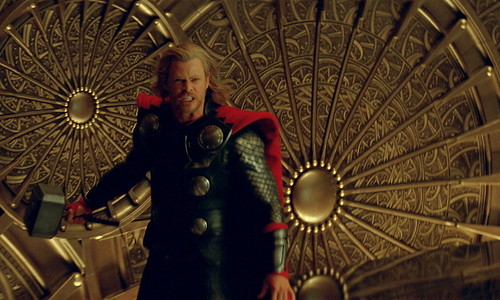
Thor


You shall not pass!
One can’t say Kenneth Branagh's Thor isn’t ambitious. This adaptation of a comic book based on Norse mythology includes romance, humor, family drama, and lots of special effects. Unfortunately, the film is a confusing mish mash, aspiring to be both more and less than what it is.

The film begins in a New Mexican desert and awkwardly segues into a distant flashback, before moving into a more recent flashback and then back to the present. The recent flashback follows the warrior Thor (Chris Hemsworth), son of Odin (Anthony Hopkins), king of the planet Asgard. Thor’s arrogance lands him on Earth many miles from home. Confused and frustrated, he stumbles upon a group of scientists, at least one of whom, Jane (Natalie Portman), is willing to overlook his bizarre behavior and help him find a way home.

Just because you are blond and I am not doesn't mean I'm bad.

One section of this film is set in Asgard, a visual creation both kitschy and beautiful. A much lighter section involves Thor’s humorous adjustment to Earth. Yet another section involves S.H.I.E.L.D., a group of government agents who are interested in an unmovable hammer which Odin threw to earth.

The script is an odd mixture of genuinely funny and unintentionally humorous. The social and physical laws that govern Asgard are hardly explained, and the pacing picks up when our hero falls to Earth. The agents are present to connect Thor to other superhero films produced by Marvel, and S.H.I.E.L.D.’s role is entirely unrelated to the plot. However, its scenes are some of the most functional in the movie.

Or does it?

The actors seem to be in several different films. Hemsworth fares well as Thor, seamlessly shifting between several genres. His transformation from cocky to contrite to compassionate is far more believable than his love story. Portman’s Jane is cute and her attraction to Thor is understandable, but the film implies that they fall in love without showing us how. Watching them giggle at one another is not particularly gripping.

Kat Dennings, who plays Jane’s assistant Darcy, is natural in her delivery of amusing one-liners. Thor’s friends, The Warriors Three, seem to have stepped out of a science fiction show, Hopkins is low key as the patriarch, and Renee Russo has a thankless, tiny role as Thor’s helpless mother. Colm Feore does his best as Laufey, leader of the blue Frost Giants, and a great Idris Elba plays a seemingly implacable gatekeeper to other worlds.

The power of Christ compels you!

Most baffling (and, in some ways, interesting) is Thor’s brother Loki, played by Tom Hiddleston. He appears to be in five different movies. Loki is almost as important a character as Thor. Too little time is spent with him to completely understand his motivations, but because the audience follows his character, the tricks he pulls feel like tricks on the audience. Alternately calculated and extremely emotional, he is more bizarre than intriguingly ambiguous. Hiddleston gives an expressive, even furious performance, making his campier moments stand out all the more.

Patrick Doyle’s soundtrack is stirring. Sometimes its high quality only emphasizes what the film lacks. In the end, Thor’s numerous distractions prevent it from either remaining lighthearted or developing its mythological elements. Weighed down by special effects, action, and dumb lines, Thor is an original idea that seems determined to be a mediocre film.

You are hot therefore I love you.

Thursday, July 7, 2011

Jane Eyre: A Rare, Unearthly Thing


Cary Fukunaga has directed an ethereal version of Charlotte Brontë’s oft-adapted novel Jane Eyre. The film’s muted visuals convey the gothic story’s mystery while hinting at its internal passions.

Our heroine is Jane Eyre (Amelia Clarkson), whose childhood involves characters who resemble the grim child abusers of a Charles Dickens novel. The plot’s pace quickens once Jane reaches young adulthood (then played by Mia Wasikowska) and moves to Thornfield Manor, a forbidding castle surrounded by equally impressive grounds. There she encounters housekeeper Mrs. Fairfax (Judi Dench) and begins tutoring the lord’s French ward Adele (Romy Settbon Moore). Mrs. Fairfax tells Jane that Lord Edward Rochester (Michael Fassbender) has moods that are as unpredictable as his travels. Jane feels drawn to Rochester, even though she feels that the more she learns about him, the less she knows.


Here Jane’s renowned “plainness” comes from her soft features and downtrodden position. Wasikowska’s youth contributes to the character’s believable confusion and sexual curiosity. Most importantly, she conveys Jane’s stoicism, wisdom, and imagination. Fassbender’s Rochester is slightly frightening but magnetic, amusing, and acutely observant. He tells Jane that she is no more “naturally austere, any more than [he is] naturally vicious.” She is as sharp as he is, and correctly describes him as “the most phantom-like of all” her “unreal” experiences at Thornfield. Fukanaga brings out the novel’s poetic language, making mere exchanges of words more intense and erotic than many lovemaking scenes.

Inspired by Northern English folk music and gypsy fiddling, Daro Marianelli’s sweetly passionate score is haunting. Yet the film’s painterly aesthetic, from a stormy sunset to the resonant final image, is the movie’s most prominent aspect. While Fukunaga’s attention to historical detail lends a realistic rawness, the movie’s exquisite colors convey a fairy-tale-like quality, accentuating Rochester and Jane’s allusions to magic.


Thornfield is alternately beautiful and menacing. A naturally-lit nude painting evokes a sense both ominous and sensual, much like Jane’s attraction to Rochester. An individual who feels trapped is silhouetted against a window showcasing other worlds. Jane and Rochester are filmed outside in a way that makes them appear to be spirits of nature.

Wasikowska sometimes underplays the deceptively tame Jane, and Fassbender is occasionally too dramatic. On the surface, this is a straightforward if suspenseful adaptation of Brontë’s classic melodrama. But beneath is a rapturous, even transcendent tale.

Saturday, June 18, 2011

X-Men: First Class


Magneto vs. missiles

Scene: 1960s. Cold War.

As Erik Lehnsherr (Michael Fassbender) hunts down former Nazis, Charles Xavier (James McAvoy) studies at Oxford. Erik spent World War II in a concentration camp. Charles lived in luxury, but his parents were never around. His company was a girl about his age named Raven (Jennifer Lawrence). Former Nazi Sebastian Shaw (Kevin Bacon) plots to start World War III, so Erik, Charles, Raven, and a rag-tag group join together to stop him.

Oh, yeah, and they have superpowers. They’re mutated humans, and few know of their existence. Those who do know tend to fear and loathe them, making most mutants feel alone and discriminated against. METAPHOR.

If I had gone in expecting a James Bond film, I might have had a better idea of what to expect. This prequel to the other X-Men films had possibilities. We know from later films that Charles and Erik become leaders with opposing philosophies, even as they appear to share a genuine affection. How fun could it be to see their relationship develop?

The answer is pretty fun but also very stupid.

His mutant power is to fly upside down.

What they got wrong:

Dialogue
Some of the dialogue is cringe worthy and unbelievably cliché. How many times have we heard the phrase, “Who are you and what have you done with (etc.)” or “God help us all?” This may be paying homage to the past, but this knowledge doesn’t make the horrendous lines any easier on the ears.

Humans/Non-mutants/Muggles
Mutants are putting their lives on the line for lowly humans, but the big question here is, will the humans ever accept the mutants? Is it really worth saving a people who may very well turn against you? The film attempts to answer that question and show ambiguity by making almost every human character grating, irrationally stupid, and self-centered. Several minor characters (mostly humans) deliver their terrible lines in an especially wooden manner. This makes the stakes feel remarkably low. That’s quite an accomplishment considering the stakes are World War III.

History
Obviously, this is an alternate history. However, First Class is no Inglourious Basterds, a complex, satirical take on World War II. This film portrays two terrifying time periods in history, the Holocaust and the Cold War, with an offensive mixture of melodrama and lightheartedness. A figure resembling the sickening Nazi doctor Josef Mengele resembles a James Bond villain, gleefully shooting down an innocent Jewish woman. Was anyone else uncomfortable with this?

Race Relations (Spoiler Alert)
The film states its message about fifty times: be proud of your identity, no matter what your appearance. Yet the only African American man (Edi Gathegi, potentially interesting) in the film is one of only two mutants to be killed. The other is a Nazi.

Consistency
As is expected, there are several moments that make no sense. You might find yourself asking, how did that character know that other character’s name? Or, why aren’t they moving when they are in grave danger? Those questions are far less important than several puzzling allegiance shifts. Let’s just say a few characters who appear to be horrified when witnessing mass murder somehow become smug accomplices.

Professor X. (Note: if someone makes this gesture, he or she is reading your mind.)

What they got right:

Style
The design department had great fun with generic but iconic clothes and music of the 1960s. Prepare for turtlenecks and short skirts (and, because this is a comic book movie, cleavage).

Erik and Charles
The relationship between Erik and Charles is quite touching. Charles (dubbed Professor X) is a witty, confident, and believably inspiring leader. McAvoy is likable and surprisingly hilarious in the role. Charles uses his telepathic ability to help Erik (Magneto) control his unbalanced emotions. Erik uses his ability to mentally manipulate metal to pulverize his enemies. Erik is insightful, ruthless, and disturbed. Intense as always, Fassbender is engaging whether terrorizing bad-guys, fighting the darkness within, or giving acute advice to younger mutants.

Mutants
Raven (later named Mystique) has a fairly nice story as a blue shapeshifter embarrassed by her natural appearance. Nicholas Hoult does well as a scientist who is ashamed of his fancy feet, capturing both the character’s diffidence and gruffer side. Scenes involving mutant abilities are in some ways superior to the other X-Men films because characters use their powers to full effect (i.e. they do not unnecessarily backflip or punch others when they could shoot them with lasers). On the whole, the action is quite entertaining and certainly one of the best aspects of this film.

Villains
Kevin Bacon has fun as the nefarious Shaw, and his trio of suave baddies remains confident and calm in every situation. The serene Emma Frost (January Jones) is a telepath who wears mostly undies and can turn her skin into a protective veneer of diamonds. The other two henchmen have a very small amount of screen time. One has at most five lines. The other has none. Still, Riptide (Alex Gonzalez) has an amusing ability to keep his hair and outfit perfectly in place while creating tornadoes, and Azazel (Jason Flemyng) bears a demonic appearance, possesses stunning assassination skills, and can teleport in a burst of flames. (Can anyone blame him for joining the villains? Who would trust a guy who looks like the devil?)

Story
There is an actual arc, including a climax featuring several satisfying action sequences and some emotional resolution. There’s even a little tragedy and surprise.

A satisfying bromance. Professor X tries to help his troubled friend.

Conclusion

X-Men: First Class should be enjoyable for anyone who has followed the X-Men series. It’s an entertaining film which improves as it progresses. Unfortunately, it is not also a good film.

Staring at a demonstration of mutant power the professor's mansion