Wednesday, January 23, 2013

Polisse


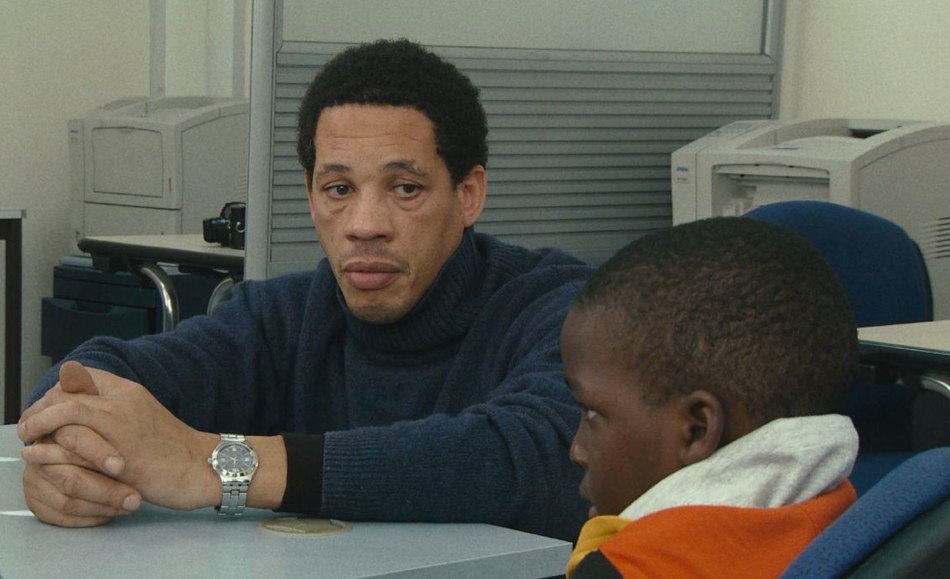
Maiwenn's excellent police drama Polisse follows the Parisian Child Protection Unit, expertly weaving officers' personal and work lives. Maiwenn plays Melissa, a quiet photographer who is more of a cipher than a fully drawn character, but she serves as the audience's eyes. The force is filled with more dynamic characters, including Joey Starr's passionate Fred, Karin Viard's insecure Nadine, and Marina Fois's bitter Iris.

The workers are dedicated professionals, but that isn't to say they are patient or polite. Often more intimate with their peers than their lovers, they are more reliable parents than spouses. Plagued with alcoholism, depression, and neuroses, there is a sense that our heroes could explode at any time. In fact, many of them do, and their rants about the trials of their job are repetitive but believable. In spite of the numerous storylines, careful editing and naturalistic, sometimes unbearably raw, acting distinguishes the various characters.

This work is neither easy nor cut-and-dried. Suspects range from tearful to unrepentant, and the young victims sometimes don't want to be torn away from their abusers. Relationships between the officers are also intense and complicated, whether they are platonic friendships or romances, repressed or consummated. In spite of the harrowing subject matter, characters often mask their pain as humor, and there are rare moments of relief and pure jubilation.

While some plots are underdeveloped (this would have been a fascinating miniseries), the film manages to follow quite a few stories as well as touch on broader issues such as bureaucracy and cultural clashes. The conclusion is simultaneously inconclusive, heavy-handed, and effective, suggesting that these prickly workers struggle through life and sacrifice themselves for the children. Aided by hand-held camera work, the gripping Polisse feels real.

French with English subtitles.

Saturday, December 29, 2012

Queen of Versailles


Lauren Greenfield's masterful documentary The Queen of Versailles follows billionaire David Siegel and his beautiful wife Jacqueline into the great recession. They live in Florida where nannies tend to their eight children, one of whom they "inherited." While in the middle of building the largest house in the United States (inspired by Versailles), the economic crisis hits. David's timeshare empire, the biggest in the world, faces severe cutbacks.

Few tears are shed. The Siegels can be hilariously clueless and outrageous, but they also share moments of regret and generosity. As monetary woes sink in, the excess which was a source of pride for the couple becomes a garish nightmare. In spite of her degree in computer engineering, the buxom, botoxed Jackie claims to be in the dark about their financial situation. David becomes consumed with saving his company, often ignoring the rest of his family or lashing out at Jackie, who admits that she is living in a fantasy world. (The movie's apt title recalls Marie Antoinette and her notorious decadence.)

Before the crisis, one of their many children says it best: they never think about money, but they always think about money. The sense of anxiety hanging over the Siegels will be familiar to many Americans, but their opulence will not. David and Jackie blame the banks for lending them too much money, even though David's cutthroat Westgate Resorts dangles the American Dream in front of people who likely can't afford it.

This well-edited movie interviews the Siegels, their children, employees, servants, and old friends. We find out that the hired help have the smallest rooms in the house and haven't seen their family in years. They tend to children who, along with the pets, appear to be accessories. When David embarks on a Citizen Cane like quest to rescue his wealth, it's not difficult to conclude that Jackie, and perhaps all women, are also possessions to many men in the moneyed world. Hints at strained or broken family relationships are also telling.

This searing family portrait illuminates both the current state of the country and the effect of money on the psyche. The film doesn't clearly track the trajectory of David's company, but it does display hollow, disturbing, and even repulsive results of great wealth.

Wednesday, December 26, 2012

Horrible Bosses


Horrible Bosses opens with Nick, Dale, and Kurt describing their contentment with their work. Nick (Jason Bateman) works night and day at a high-powered company, Dale feels comfortable as a dental assistant and fiance, and Kurt (Jason Sudeikis) enjoys working for a kindly boss (Donald Sutherland) in a family-like work environment. Unfortunately, Nick's boss Dave (Kevin Spacey) is cruel and manipulative, Dale's boss Julia (Jennifer Anniston) sexually harasses and blackmails him, and Kurt's boss dies only to be replaced by his decadent, moronic, and mean son Bobby (Colin Farrell). They decide that, due to their bosses' destructive and deceitful natures, their best option is to kill one another's employers.

The talented cast never quite gels due to thinly drawn characters. Bateman is especially good as his usual deadpan self, but Day's edgy naturalism and occasional ham only reminds one of his much funnier television show It's Always Sunny in Philadelphia. Sudeikis's Kurt is fairly likable, yet his character is just another example of how the average guy can get any model to fall in bed with him.

The idea that workers submit themselves to bad conditions in an economy is touched upon here, as is the fact that men can be sexually harassed (though the situation is played for laughs). Horrible Bosses had potential but didn't tickle my funny bone.

Monday, December 24, 2012

Argo


Argo is a good film. It has the kind of tight direction Ben Affleck can handle with ease, but it is also too tidy. Based on a true story about a CIA operation during the Iran hostage crisis, the film hits all the right notes. It features edgy camerawork, period detail, and tense moments. The opening voiceover explains the history and sources of anti-American sentiment without downplaying the destructive state of the revolution.

If you are interested in a mostly unknown stint in which a CIA agent posed as a filmmaker, check it out. Prepare to recognize a host of faces. Still, the movie feels a bit pat. Some of Argo's scenes are intercut to build tension, yet they also feel a tad predictable and manipulative. In spite of its searing place in history, I didn't find Argo particularly memorable.

Saturday, October 27, 2012

2 Days in New York


Julie Delpy's disappointing sequel to 2 Days in Paris finds its French heroine Marion in a happy relationship with Mingus (Chris Rock). They each have a child by an ex (in Marion's case, it is from her boyfriend in 2 Days in Paris). But their relationship is almost destroyed when Marion's father, exhibitionist sister, and her sister's boyfriend (also a distant ex) visit.

The acting is good. There area a few humorous cameos. Delpy is an appealing presence, and Rock is inherently clever. There is some touching commentary on the subtle ways in which Marion's family deals with the recent loss of her mother. Mingus has an amusing relationship with a cardboard cutout of Barack Obama.

Unfortunately, the film mostly goes for tired stereotypes and predictable gags. The French visitors are mostly pro-Obama, but they make some awkward racial comments. The men leer at the women in a large yoga class. Mingus is sometimes baffled by the French arguments. This cultural clash was already explored more humorously and thoroughly in the previous film, so these moments feel like a rehash.

Other parts are surreal and creative, but often more bizarre than funny. One can't blame Delpy for experimenting. Hopefully her next film will be more fulfilling.

Thursday, October 25, 2012

Shaun of the Dead


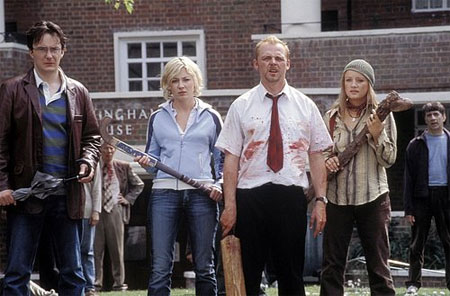
Edgar Wright's cult classic Shaun of the Dead follows the titular Shaun (Simon Pegg), a nice salesman who feels as though his life is going nowhere. His girlfriend Liz (Kate Ashfield) is disappointed in his lack of ambition. Shaun's best friend Ed (Nick Frost) epitomizes this arrested development. Ed's simian humor (he literally imitates gorillas) amuses Shaun to no end, but leaves their other roommate, Shaun's girlfriend, and her judgmental roommates Diane and Dylan (Lucy Davis and Dylan Moran) cold.

In the midst of his personal problems, Shaun finds himself in the middle of a zombie apocalypse. Is this his chance to find his inner strength and get his life together? That is, if he survives?

This comedy has amusing and surreal moments of silliness and satire, but its humor isn't for everyone. For those whose funny bone it doesn't strike, the film's strength comes from its metaphors. Shaun feels stuck in his routines, held back and a little dead inside--not unlike a zombie. In fact, the drones populating the city of London already resemble the living dead. Shaun is so oblivious to his fellow humans and the world around him, he hardly realizes an epidemic is upon them.


Our hero's journey from overlooked "loser" to courageous leader is also satisfying. He finds himself torn between the well-intended but prepubescent friend of his youth and his girlfriend's affections. This is as much a relationship film as it is a horror movie.

There are some bloody moments, though. Horror and horror-spoof fans will enjoy watching the nonplussed Shaun and his best mate battle zombies. Others might find the film diverting but not particularly memorable. Many might connect to a man in his thirties who is trying to find himself--zombie infestation or no.

Tuesday, October 23, 2012

Citizen Gangster


Citizen Gangster follows real-life figure Edwin Boyd (Scott Speedman) as he transitions from bus driver to theatrical bank robber. A World War II veteran, Edwin struggles to support his wife Doreen (Kelly Reilly) and two children, and dreams of being an actor. One day, he dons makeup and robs a bank at gunpoint. He realizes that, aided by his athletic abilities, this is easy money. Not to mention, he gains the thrill of attention he's always wanted.

In spite of his short-lived joy, the film's bleak colors convey Edwin's depressing, increasingly desperate situation. Unfortunately, the audience never quite connects the rather passive, mild mannered man to his wilder counterpart. The movie also depicts the robberies as more surreal, bemusing, and exciting than harmful, perhaps in order to convey how the media romanticized Boyd's crimes.

The story touches on Edwin's relationship with his father (Brian Cox), a retired policeman, but their complex history is not fully explored. Partway through the film, Kevin Durand brightens the screen as fellow bank robber and veteran Lenny Jackson. Unlike his mostly forgettable criminal friends, Lenny shows believable volatility and unexpected heart. Though not one to be messed with, he latches onto Edwin like a brother. The genuine bond between Edwin and Lenny is one of the most successful aspects of the film.

Their descent into living above the law is not glamorized. Boyd's relationship with his wife is increasingly strained, and the affect his actions have on his family is painful to watch. Still, though well made, the biopic Citizen Gangster never becomes more than the sum of its parts.